

What Clients Expected From Financial Advisers: During 2020, clients expected financial advisers to provide clarity, realistic timescales and regular communication.
Technology helped advisers manage cases remotely. However, clients still valued human judgement and personal explanations.
For mortgage advisers, the central lesson was practical. Good advice depended on accurate information, suitable recommendations and clear updates throughout the application.
Financial advice during an uncertain period
The financial conditions of 2020 changed how many clients approached mortgage and financial decisions.
Income disruption, furlough, payment holidays and employment uncertainty affected household confidence. Lenders also reviewed criteria, affordability policies and acceptable evidence.
Clients did not only want access to a mortgage product. They wanted to understand whether an application remained realistic.
This placed greater importance on the adviser’s ability to:
- establish the client’s current circumstances;
- identify recent changes to income or expenditure;
- explain lender requirements;
- set realistic application timescales;
- discuss possible barriers before submission;
- keep the client informed.
Uncertainty does not remove the need for careful decisions. It increases the value of clear evidence and measured explanations.
What did clients expect from financial advisers?
Clear explanations
Clients needed advisers to explain how changes in income, deposits or credit commitments could affect an application.
Technical information had to be translated into practical consequences. This included explaining affordability assessments, loan-to-value limits and document requirements.
Clients were less likely to benefit from general reassurance alone. They needed to know what could be done, what evidence was required and what might prevent an application from proceeding.
Realistic expectations
A suitable recommendation begins with an accurate assessment of the client’s circumstances.
During 2020, lender processing times and criteria could change quickly. Advisers therefore needed to avoid promising an outcome before reviewing the available evidence.
Realistic guidance could cover:
- whether the client met the lender’s published criteria;
- how furloughed or reduced income might be assessed;
- whether further documents were required;
- when a valuation could take place;
- how long underwriting might take;
- whether another lending route should be considered.
Confidence is valuable when it is supported by evidence. Unsupported certainty can create greater concern later.
Regular case updates
Clients often judge an advice service by the quality of its communication.
An update remained useful even when an application had not moved forward. It confirmed that the adviser was monitoring the case and had not lost sight of the client.
Advisers could improve communication by agreeing:
- how updates would be provided;
- how often contact would take place;
- who would deal with document requests;
- when the client should expect the next decision;
- which delays were outside the adviser’s control.
A clear communication process could reduce repeated enquiries and help clients understand each stage.
Why the basic advice process still mattered
Periods of disruption can encourage businesses to concentrate on new systems and urgent problems. However, the foundations of suitable advice remain consistent.
Mortgage advisers still needed to complete accurate fact-finds, assess affordability and document the reasons for their recommendations.
The practical basics included:
- Establishing the client’s needs and objectives.
- Confirming income, expenditure and existing commitments.
- Checking the property and proposed mortgage structure.
- Researching suitable lender criteria.
- Explaining costs, risks and limitations.
- Recording why the recommendation was suitable.
- Maintaining contact until the case completed.
Connect supports these activities through its wider complete mortgage network proposition for UK brokers.
Technology should support human advice
Video meetings, digital documents and online case systems became increasingly important during 2020.
These tools allowed advisers to collect information and progress applications without relying on face-to-face meetings. They also helped firms maintain records and respond to document requests.
However, technology did not replace the adviser’s judgement.
A sourcing system could identify products that matched selected criteria. It could not fully assess the client’s concerns, explain compromises or decide how much detail the client needed.
Technology was most effective when it supported:
- secure document collection;
- accurate record keeping;
- criteria research;
- application tracking;
- scheduled communication;
- consistent compliance processes.
Connect’s adviser services provide access to practical support across referrals, packaging and specialist case placement.
When should an adviser refer a client?
An adviser may identify a need outside their permissions, knowledge or available service.
In that situation, continuing without the correct competence could expose the client and firm to unnecessary risk.
A structured mortgage referral service for advisers can help clients reach an adviser with the relevant permissions and experience.
Referral should not be treated as losing a relationship. It can demonstrate that the client’s needs have been placed before the desire to retain every case.
How adviser visibility supported client choice
Clients also wanted greater control over who they contacted.
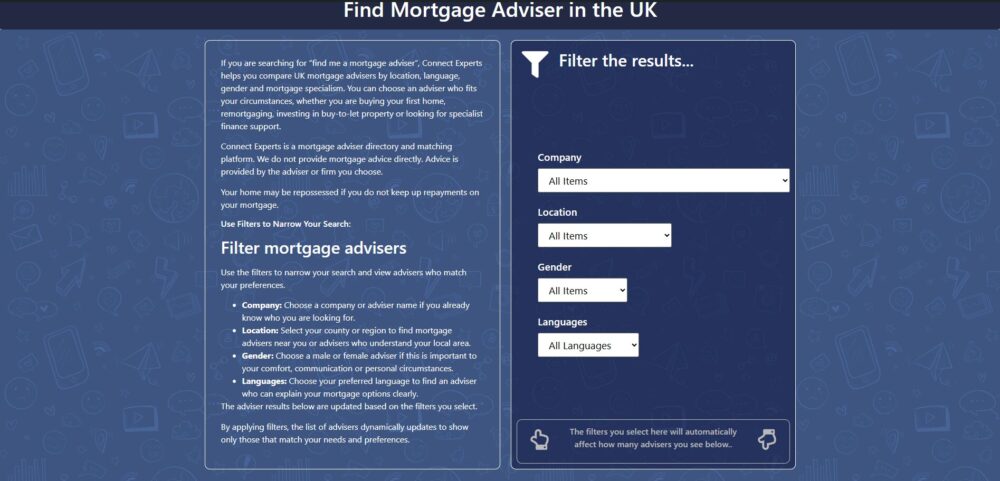
The Connect Experts mortgage adviser directory allows consumers to search for advisers using practical criteria. These include location, language, gender and mortgage type.
Connect Experts is a directory and matching platform. It does not provide mortgage advice directly. Advice is provided by the adviser or firm selected by the consumer.
For appointed representatives, a detailed directory profile can support visibility in Google and AI-assisted searches. Profile information should remain accurate, specific and consistent with the adviser’s permissions.
What could mortgage advisers learn from 2020?
The events of 2020 reinforced a lasting principle.
Clients do not judge an adviser only by the product secured. They also judge whether the process was understandable, realistic and professionally managed.
For a mortgage network, supporting that standard requires more than lender access. It requires systems, compliance oversight, training, case support and clear routes for specialist referrals.
Mortgage advisers considering a network should therefore examine the complete support structure, not only the product panel.
Advisers can speak to Connect about joining the network and discuss their experience, permissions and business plans.
Frequently asked questions
What did clients want from financial advisers in 2020?
Clients wanted clear explanations, realistic expectations and regular communication. They also needed advisers to explain how changing lender criteria could affect their applications.
Why was communication important during mortgage applications?
Application timescales were less predictable. Regular updates helped clients understand delays, document requests and the next stage of the process.
Did technology replace financial advisers?
No. Technology supported research, document collection and communication. Adviser judgement remained necessary when assessing needs, suitability and possible compromises.
How can a mortgage network support advisers?
A mortgage network can provide regulatory oversight, compliance guidance, lender access, training, technology, case placement and business support.
Can an adviser refer a case outside their permissions?
Yes. A structured referral process can help the client obtain advice from a suitably qualified and permitted adviser.