
Mortgage Advisers: Good mortgage advice depends on more than selecting a suitable product.
An adviser must understand the client’s circumstances, test the recommendation and record why the proposed mortgage meets an identified need. The quality of that record matters because a sound decision should remain understandable after the conversation has ended.
This principle has become more important since the Consumer Duty came into force for open products and services in July 2023.
At a Glance
Mortgage advisers can evidence better client outcomes by:
- Completing a detailed and current fact-find.
- Identifying the client’s objectives and foreseeable risks.
- Comparing suitable options rather than rates alone.
- Explaining costs, limitations and possible future changes.
- Recording why alternatives were discounted.
- Checking that the client understood the recommendation.
- Scheduling reviews where future circumstances may affect suitability.
A good file should explain the decision, not merely record the product selected.
What Does Evidencing a Client Outcome Mean?
Evidencing an outcome means creating a clear record of how the advice process addressed the client’s needs.
The file should show:
- What the client wanted to achieve.
- Which financial and personal circumstances were considered.
- What risks were identified.
- Which mortgage options were assessed.
- Why the recommended option was considered suitable.
- What information and warnings were given.
- How the adviser checked the client’s understanding.
A completed application does not provide this evidence by itself. The reasoning behind the recommendation must also be recorded.
Advisers who require further guidance can review the network’s approach to mortgage compliance support.
Start With the Client’s Actual Objective
A client may initially ask for the lowest available rate. However, the lowest rate may not satisfy the wider objective.
The adviser should establish whether the client values:
- Payment certainty.
- Flexible overpayments.
- A shorter mortgage term.
- Early repayment flexibility.
- Future property plans.
- A specific repayment method.
- Protection against possible payment increases.
The objective must be precise enough to test the recommendation against it.
For example, “the client wants a fixed rate” provides little context. A stronger record would explain that the client requires stable payments for five years because household income is expected to remain broadly unchanged.
Record Relevant Future Changes
Mortgage advice is based on current information, but foreseeable changes may affect the outcome.
Relevant changes could include:
- Retirement during the proposed term.
- Planned self-employment.
- Maternity or parental leave.
- A reduction in working hours.
- Expanding a property portfolio.
- Moving home.
- Expected changes to household expenditure.
- The end of an interest-only repayment strategy.
The adviser does not need to predict every possible event. However, known or reasonably foreseeable changes should be considered before the recommendation is made.
Compare More Than the Initial Rate
Headline rates can be useful, but they do not show the full cost or practical effect of a mortgage.
A suitable comparison may include:
- Initial monthly payments.
- Product fees.
- Valuation and legal costs.
- Early repayment charges.
- Reversion rates.
- Overpayment allowances.
- Portability conditions.
- Mortgage term.
- Total cost during the initial period.
- Product eligibility and property restrictions.
A product with a lower rate may cost more after fees. It may also provide less flexibility than the client requires.
The suitability record should explain which factors influenced the recommendation.
Explain Why Other Options Were Discounted
A strong file does not need to document every mortgage in the market. It should explain why realistic alternatives were not recommended.
For example:
- A tracker rate was discounted because the client required payment certainty.
- A shorter fixed period was discounted because the client expected limited financial flexibility.
- A product with a lower rate was discounted because its fee increased the overall cost.
- An interest-only option was discounted because no credible repayment strategy was available.
- A longer mortgage term was discounted because the additional interest conflicted with the client’s objective.
This creates a clear connection between the fact-find, the research and the final recommendation.
Make Risk Explanations Specific
Generic warnings may not demonstrate that the client understood the risks relevant to their mortgage.
Risk explanations should relate directly to the recommendation. These might cover:
- Payments increasing after the fixed period.
- Early repayment charges.
- The effect of extending the mortgage term.
- Interest-only repayment risks.
- Consolidating unsecured borrowing into a secured loan.
- Variable rental income for buy-to-let clients.
- Property restrictions affecting future refinancing.
- The consequences of missed payments.
The adviser should record both the explanation and the client’s response.
Check Client Understanding
Clear communication is part of producing a good outcome.
Technical terms should be translated into practical consequences. Advisers can confirm understanding by asking the client to explain key features in their own words.
The record could confirm that the client understood:
- The expected monthly payment.
- When that payment could change.
- The fees being added or paid separately.
- Any early repayment restrictions.
- The proposed mortgage term.
- The effect of missed payments.
- The next steps after the initial product period.
This is particularly important where the client has limited mortgage experience, communication needs or more complex circumstances.
Use Reviews as Part of the Advice Process
Suitability should not always be treated as a one-time assessment.
A review may be appropriate when:
- A fixed or discounted period is approaching its end.
- The client’s income has changed.
- The property is being let or transferred.
- The client plans to move.
- Interest-only arrangements require reassessment.
- Protection needs have changed.
- The client has taken further borrowing.
A planned review creates a defined point for checking whether the original mortgage still meets the client’s circumstances.
How a Mortgage Network Can Support Better Records
A mortgage network can provide a consistent framework for documenting advice.
Support may include:
- Fact-find and suitability templates.
- Compliance guidance.
- File-checking procedures.
- Adviser training.
- Lender and criteria updates.
- Case-placement support.
- Customer relationship management systems.
- Escalation routes for complex cases.
Experienced advisers can learn more about how mortgage networks support mortgage advisers across compliance, technology, training and case placement.
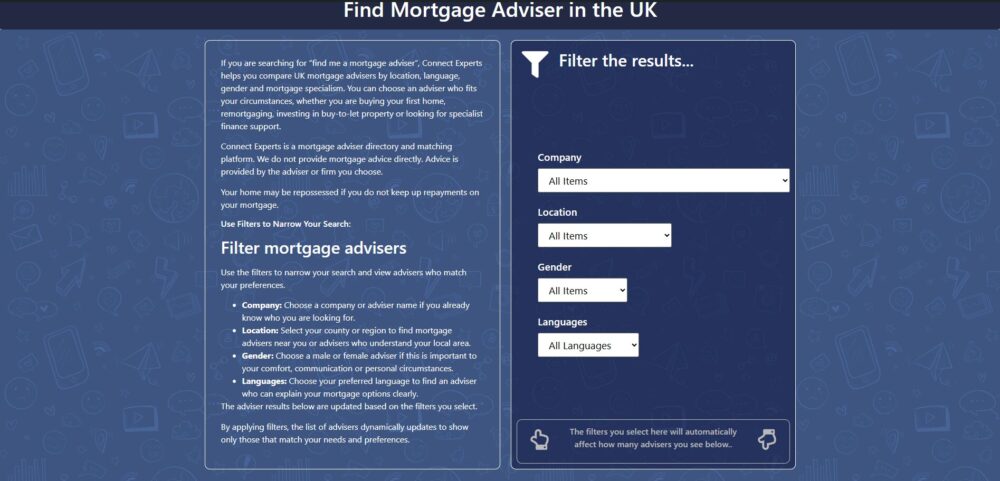
Connect Network appointed representatives may also receive consumer visibility through the Connect Experts mortgage adviser directory. The directory allows consumers to search for advisers using criteria such as location, mortgage type, language and other preferences.
Better Records Support Better Decisions
Advice is strongest when another qualified person can understand how the recommendation was reached.
A clear file should connect:
- The client’s circumstances.
- The client’s stated objective.
- The options considered.
- The risks identified.
- The recommendation made.
- The client’s understanding.
- Any required future review.
This structure supports regulatory oversight, improves consistency and helps advisers explain their professional judgement.
The purpose of documentation is not to make the advice process longer. It is to make the decision clearer.
Speak to Connect Network
Connect Network supports experienced mortgage advisers with compliance guidance, lender access, training, technology and specialist case support.
Explore how to join Connect Network and discuss the structure required for your advice business.