
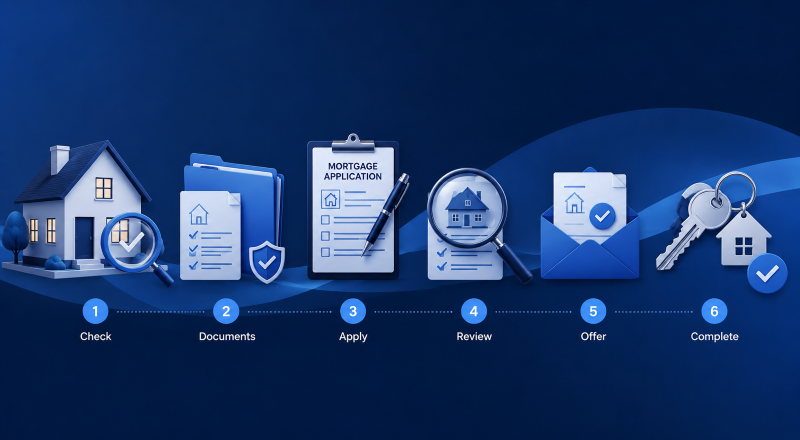
Mortgage Application Process: A mortgage application is not one decision followed by an approval. It is a structured sequence of checks involving the borrower, mortgage adviser, lender, valuer and solicitor.
Each stage supplies evidence for the next. Therefore, accurate information at the beginning can prevent delays later.
How the Mortgage Application Process Works
The mortgage application process normally includes:
- Completing a fact-find
- Assessing affordability
- Reviewing credit history and lender criteria
- Obtaining an Agreement in Principle
- Selecting a property and mortgage product
- Preparing supporting documents
- Submitting the full application
- Completing valuation and underwriting
- Receiving the mortgage offer
- Finishing the legal work and completing
An Agreement in Principle is not a mortgage guarantee. Final approval depends on the full application, supporting evidence, property and lender underwriting.
1. Initial Mortgage Fact-Find
The mortgage adviser begins by gathering information about the applicant’s circumstances and objectives.
The fact-find may cover:
- income and employment
- regular expenditure
- existing credit commitments
- available deposit
- credit history
- property plans
- preferred mortgage term
- expected future changes
The quality of this information matters. Mortgage research can only be accurate when it is based on complete and current facts.
Our guide to the role of a mortgage broker explains how advisers support research, applications and lender communication.
2. Affordability and Eligibility Assessment
Affordability is not based on income alone.
Lenders may assess income, expenditure, dependants, debts, mortgage term and possible changes in interest rates. Their calculations and acceptable income rules can differ.
The adviser also reviews basic eligibility. This can include age, residency, employment status, deposit source and property purpose.
Read the residential mortgage guide for a wider explanation of residential lender requirements.
3. Credit and Lender Criteria Checks
The applicant’s credit history may affect the lenders and products available.
A credit report can show:
- active borrowing
- repayment history
- missed payments
- defaults
- county court judgments
- financial associations
- address history
- credit utilisation
A credit score does not decide the application by itself. Each lender applies its own policy and underwriting approach.
The adviser should compare the complete circumstances against lender criteria before recommending an application route.
4. Agreement in Principle
An Agreement in Principle, or AIP, indicates how much a lender may consider lending based on initial information.
It may involve a soft or hard credit search, depending on the lender.
An AIP can help demonstrate that the applicant has considered mortgage funding. However, it is not a formal mortgage offer.
The lender can still decline or change its decision after reviewing the full documents, property and application.
5. Property and Product Selection
Once a property has been identified, the adviser can complete more detailed mortgage research.
The research may consider:
- purchase price
- required loan
- loan-to-value ratio
- mortgage term
- repayment method
- interest rate type
- product fees
- early repayment charges
- lender criteria
- overall cost
The lowest advertised interest rate is not automatically the most suitable option. Fees, incentives and restrictions can change the total cost.
6. Mortgage Document Preparation
The lender normally requires evidence supporting the information in the application.
Documents may include:
- proof of identity
- proof of address
- recent bank statements
- payslips
- P60
- tax calculations or accounts
- deposit evidence
- gifted deposit confirmation
- evidence of existing commitments
- property details
Requirements depend on the applicant and lender. Documents should be complete, legible and consistent.
Connect provides mortgage packaging support for brokers to help advisers prepare clear, lender-ready applications.
7. Full Mortgage Application
The adviser submits the application with the selected mortgage product and supporting information.
Accuracy is essential. Differences between the application, credit report and documents can generate further questions.
After submission, the lender may request extra evidence. A prompt and complete response can help keep the case moving.
8. Valuation and Underwriting
The lender arranges a valuation to assess whether the property provides acceptable security for the proposed loan.
A lender valuation is not the same as a detailed home survey. Buyers may wish to arrange a separate survey appropriate to the property.
At the same time, an underwriter reviews the application. The checks may include:
- affordability
- income evidence
- deposit source
- credit history
- property suitability
- application consistency
- lender policy
The underwriter may approve the case, request further information, amend the lending terms or decline the application.
9. Formal Mortgage Offer
The lender issues a mortgage offer when its underwriting and property requirements have been satisfied.
The offer confirms important information such as:
- mortgage amount
- mortgage term
- repayment method
- interest rate
- monthly payment
- product conditions
- expiry date
- special requirements
The applicant should review the offer with their mortgage adviser and solicitor. Any incorrect information should be raised before contracts are exchanged.
10. Conveyancing and Completion
The solicitor or conveyancer manages the legal process.
Their work may include:
- checking legal ownership
- reviewing the contract
- carrying out searches
- examining leasehold information
- raising enquiries
- reporting to the lender
- arranging exchange of contracts
- requesting mortgage funds
On completion, the lender sends the mortgage funds to the solicitor. The purchase money is transferred, and ownership passes to the buyer.
What Can Delay a Mortgage Application?
Common causes of delay include:
- missing or expired documents
- unexplained bank transactions
- inconsistent income information
- deposit evidence problems
- valuation concerns
- property title issues
- slow responses to lender questions
- changes in the applicant’s circumstances
A well-prepared application cannot remove every delay. However, it can make the case easier to assess.
The Mortgage Network’s Role
A mortgage network supports advisers with the infrastructure behind the advice process.
This can include compliance oversight, lender access, technology, training, case placement and application support.
Connect combines mainstream and specialist mortgage capability within a complete mortgage network for UK brokers.
Good technology can improve processing. Yet technology does not replace careful questioning. A successful case still depends on accurate information, suitable research and clear evidence.
Find an Adviser for Your Mortgage Application
Connect Experts is the adviser directory associated with the Connect network and other authorised firms.
Consumers can find a mortgage adviser by mortgage need, location, language and other preferences.
Those planning to buy or move home can also use the residential mortgage adviser search to identify advisers who may be able to help.
Connect Experts is a directory and matching platform. Mortgage advice is provided by the adviser or firm selected by the customer.
Mortgage Application Process FAQs
How long does a mortgage application take?
Timescales vary between cases. The lender, valuation, underwriting requirements, property chain and legal work can all affect completion.
Is an Agreement in Principle guaranteed?
No. An Agreement in Principle is an initial indication. The lender must still assess the full application, documents and property.
What does a mortgage underwriter check?
An underwriter may assess affordability, income, credit history, deposit source, property details and compliance with the lender’s criteria.
Is a lender valuation a property survey?
No. A lender valuation primarily considers the property as security for the mortgage. A buyer may arrange a separate survey for a more detailed assessment.
Can a mortgage lender request more documents?
Yes. A lender can request further evidence when information needs clarification or additional verification.
What happens after the mortgage offer?
The solicitor completes the remaining legal checks, arranges the exchange of contracts and requests the mortgage funds for completion.