

When Do Borrowers Need a Mortgage Adviser? A borrower does not always have to use a mortgage adviser. However, advice can become important when lender criteria, income, credit history or property type make the decision less straightforward.
The real question is not whether every borrower needs advice. It is whether the borrower can assess affordability, eligibility, product features and long-term risks without specialist support.
At a Glance
A mortgage adviser can assess a borrower’s circumstances before recommending a suitable mortgage.
This may be particularly useful where the borrower is self-employed, has credit issues, owns several properties or needs specialist finance.
An execution-only application may suit some borrowers. However, the lender or platform will not normally assess whether the selected mortgage is suitable for that person.
What Does a Mortgage Adviser Assess?
A mortgage recommendation should begin with the borrower rather than the available interest rate.
The adviser may review:
- Income and employment status
- Regular expenditure and financial commitments
- Deposit or available equity
- Credit history
- Property type and intended use
- Preferred mortgage term
- Repayment method
- Future plans and foreseeable changes
- Product fees and early repayment charges
These factors can affect both eligibility and suitability.
A low headline rate may carry a substantial product fee. A longer mortgage term may reduce monthly payments but increase the total interest paid. A fixed rate may provide payment certainty but restrict flexibility.
The technical value of advice lies in comparing these connected factors.
Can a Borrower Apply Without Mortgage Advice?
Some borrowers can choose an execution-only route.
Under this process, the borrower selects the mortgage without receiving a personal recommendation. The provider may supply factual information, but it does not assess whether the chosen product is suitable.
This can place more responsibility on the borrower.
They must understand the mortgage features, compare the total cost and confirm that the product fits their circumstances. They must also consider what could happen if their income, property plans or interest rate expectations change.
A borrower with straightforward circumstances and strong product knowledge may feel able to make that decision. However, access to a product does not automatically mean it is the most appropriate option.
When May Mortgage Advice Be Particularly Useful?
Advice may provide greater practical value when an application falls outside a lender’s standard profile.
Examples include:
- Self-employed or contractor income
- Recent changes in employment
- Irregular earnings or multiple income sources
- Missed payments or other credit issues
- Buy-to-let and portfolio lending
- Houses in multiple occupation
- Limited company borrowing
- Unusual construction types
- Short leasehold properties
- Bridging or commercial finance
- A mortgage extending into retirement
Different lenders can assess the same circumstances differently.
One lender may use an average of recent self-employed income. Another may consider the latest year where the business shows a credible upward trend. Buy-to-let lenders may also apply different rental calculations, stress rates and portfolio rules.
An adviser can identify these differences before an application is submitted.
How Can Advice Affect the Application Process?
A mortgage application involves more than finding an advertised rate.
The adviser may need to:
- Establish the borrower’s needs and objectives.
- Review affordability and supporting evidence.
- Research lenders whose criteria fit the case.
- Compare product costs and restrictions.
- Explain the recommendation.
- Prepare and submit the application.
- Respond to lender questions.
- Track the case through valuation, underwriting and offer.
This work can reduce avoidable applications to unsuitable lenders. It can also help ensure that documents are prepared before underwriting begins.
However, advice cannot guarantee approval. The lender makes the final decision after assessing the borrower, property and supporting information.
Why Does Mortgage Network Support Matter?
Advisers also need reliable systems behind their advice.
A mortgage network can provide compliance guidance, lender access, training, technology and case-placement support. This structure is particularly relevant when an adviser encounters an unfamiliar lender policy or a more complex borrowing requirement.
Connect Network supports appointed representative firms through its adviser services, including practical tools, lender access and specialist case support.
Its mortgage compliance support also helps advisers work within a structured advice and supervision framework.
The network does not replace the adviser’s professional judgement. It gives the adviser access to resources that can support a clearer and better-documented recommendation.
How Can Borrowers Choose an Adviser?
The appropriate adviser may depend on the borrower’s mortgage type, location and personal circumstances.
Borrowers should consider:
- The adviser’s regulated status
- Relevant mortgage permissions
- Experience with similar applications
- The range of lenders considered
- Adviser fees
- How commission is disclosed
- Whether meetings are online, by telephone or face-to-face
- How clearly the adviser explains the process
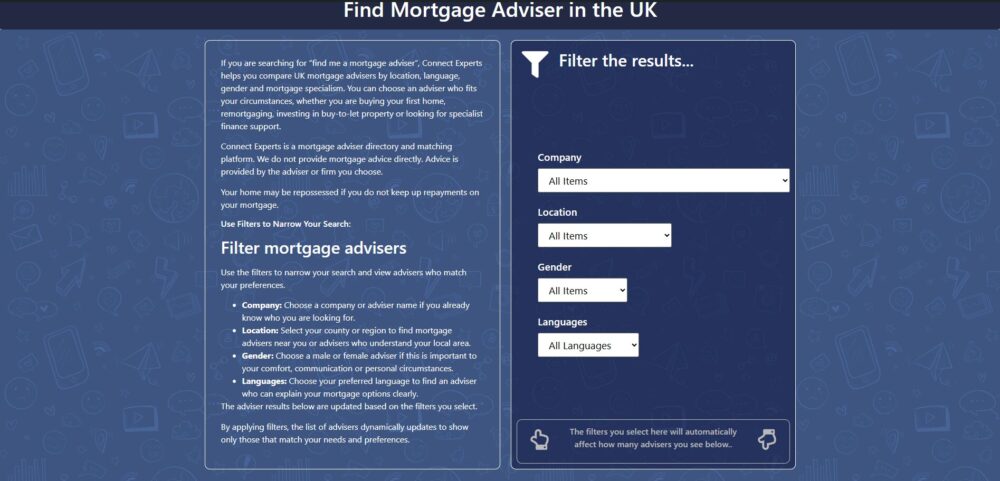
Connect Experts is the adviser directory linked to the Connect network and associated authorised firms. Borrowers can find a mortgage adviser by mortgage need and personal preference.
Those seeking local support can also search for a mortgage adviser near them.
Connect Experts is a directory and matching platform. It does not provide mortgage advice directly. Advice is provided by the adviser or firm selected by the borrower.
Do Borrowers Need Mortgage Advisers?
Not every borrower needs the same level of support.
The practical need for advice rises as the number of variables increases. Complex income, specialist property, credit history and future financial changes can all affect the suitability of a mortgage.
Digital tools can provide speed and information. A mortgage adviser adds interpretation, personal assessment and responsibility for a recommendation.
A mortgage is not only a product selected today. It is a financial commitment that must continue to work tomorrow.
Frequently Asked Questions
Is using a mortgage adviser compulsory?
No. Some borrowers can apply directly or use an execution-only service. However, they will not receive a personal recommendation through an execution-only process.
Can a mortgage adviser guarantee approval?
No. An adviser can identify suitable lenders and prepare the application, but the lender makes the final lending decision.
Does a mortgage adviser only compare interest rates?
No. An adviser should also consider fees, mortgage term, repayment type, restrictions, affordability and the borrower’s objectives.
Are all mortgage advisers able to advise on every mortgage type?
No. Adviser permissions and experience can differ. Borrowers should confirm that the adviser can assist with the mortgage or finance required.
Should borrowers check an adviser’s regulatory status?
Yes. Borrowers should check the adviser or firm on the Financial Services Register before receiving regulated mortgage advice.
Your home may be repossessed if you do not keep up repayments on your mortgage or any other debt secured on it.
The Financial Conduct Authority does not regulate some forms of buy-to-let, commercial mortgage and business finance.