

Mortgage Broker vs Lender: A mortgage broker and a mortgage lender perform different functions within the same transaction.
The lender provides the mortgage funds and decides whether the application meets its lending rules. The broker assesses the client’s needs, researches suitable options and supports the application.
For mortgage advisers, understanding this division is fundamental. A broker cannot approve a loan. Equally, a lender does not normally compare its products against those offered by competing institutions.
Mortgage Broker vs Lender
- A mortgage broker assesses the client’s circumstances and recommends a suitable mortgage, subject to permissions and service scope.
- A mortgage lender supplies the funds, sets its lending criteria and makes the underwriting decision.
- The broker prepares and submits the case.
- The lender assesses affordability, credit risk, property security and policy requirements.
- A mortgage network can support brokers with lender access, compliance, case placement and application processes.
The difference is therefore not simply who offers the mortgage. It is who advises, who funds and who makes the lending decision.
What Is a Mortgage Broker?
A mortgage broker acts as an intermediary between the client and suitable mortgage lenders.
The broker begins by gathering information about the client’s circumstances. This may include:
- Income and employment
- Deposit or available equity
- Credit history
- Existing financial commitments
- Property type and value
- Mortgage purpose
- Expected ownership structure
- Future plans and preferences
The broker then researches lenders and products within the scope of their service. They assess whether the client appears to meet the relevant criteria before recommending a suitable option.
A broker may also:
- Explain mortgage costs and conditions
- Review affordability across available lenders
- Check lender criteria before submission
- Gather supporting documents
- Prepare and submit the application
- Communicate with the lender and other parties
- Record the basis of the recommendation
- Support the client through offer and completion
The broker provides advice where authorised and permitted to do so. However, the lender retains responsibility for approving or declining the application.
Read more about the role of a mortgage broker.
What Is a Mortgage Lender?
A mortgage lender is the organisation that provides the mortgage funds.
Lenders may include banks, building societies and specialist finance providers. Each lender sets its own:
- Lending criteria
- Affordability model
- Acceptable income rules
- Credit-risk limits
- Property requirements
- Loan-to-value limits
- Product range
- Interest rates and fees
- Underwriting procedures
The lender examines the application against these rules. It may review the applicant’s income, expenditure, credit record, deposit and supporting evidence.
The lender will also consider the property being offered as security. A valuation may be required to confirm that the property meets the lender’s standards and provides suitable security for the loan.
Only the lender can issue a formal mortgage offer.
Mortgage Broker vs Lender: Main Differences
| Area | Mortgage broker | Mortgage lender |
|---|---|---|
| Primary role | Assesses needs and recommends suitable options | Supplies funds and assesses lending risk |
| Product access | Researches products from an agreed lender range | Offers its own mortgage products |
| Advice | May provide regulated mortgage advice | May provide advised or non-advised services within its own range |
| Affordability | Compares relevant lender calculations | Applies its own affordability model |
| Criteria | Interprets and compares different lending policies | Sets and applies its own policy |
| Application | Prepares, checks and submits the case | Processes and underwrites the case |
| Decision | Cannot approve the mortgage | Approves, declines or requests more information |
| Fees | May receive a client fee and lender commission | May charge product, valuation or account-related fees |
| Ongoing contact | Often supports the client throughout the case | Focuses on its own application and mortgage account |
How the Broker and Lender Work Together
A successful mortgage application depends on both roles being performed correctly.
1. The broker assesses the client
The broker completes a fact-find and identifies the client’s objectives, financial position and borrowing requirements.
2. The broker researches suitable lenders
The adviser compares relevant products and criteria. The lowest initial rate may not always provide the lowest overall cost or the most suitable terms.
3. The application is prepared
The broker collects documents and checks that the case reflects the lender’s requirements.
A complete application may reduce avoidable questions. However, good packaging does not guarantee acceptance.
4. The lender underwrites the case
The lender reviews the application, evidence, credit information and property valuation.
It may approve the case, request further information, amend the proposed terms or decline the application.
5. The broker explains the outcome
The broker helps the client understand any conditions, outstanding requirements and next steps.
This separation creates an important control. The broker advises on suitability, while the lender decides whether it is prepared to provide the funds.
Why Lender Criteria Matter to Brokers
Mortgage lenders do not assess every applicant in the same way.
Differences may arise around:
- Self-employed income
- Contractor earnings
- Bonus and commission income
- Credit history
- Portfolio landlord exposure
- Limited company buy-to-let
- Houses in multiple occupation
- Commercial property
- Non-standard construction
- Deposit sources
- Maximum applicant age
A client who does not meet one lender’s policy may meet another lender’s requirements. Equally, a case that appears affordable may still fail because of property, credit or documentation issues.
This is why lender research must examine more than the headline interest rate.
Why Mortgage Network Support Matters
The broker sits between the client and lender, but the broker may also be supported by a mortgage network.
A network can provide the regulatory and operational structure behind the advice process. Depending on the network proposition, this may include:
- Access to mainstream and specialist lenders
- Compliance guidance and supervision
- Case-placement support
- Application packaging services
- Training and continuing professional development
- Mortgage technology and systems
- Business-development support
- Marketing and adviser visibility
Connect provides a complete mortgage network for UK brokers across mainstream and specialist lending areas.
Its wider adviser services can also support cases where an adviser needs packaging, referral or specialist assistance.
The principle is practical. A broker’s judgement is strengthened when the structure behind the broker supports accurate research, suitable advice and well-prepared submissions.
Broker Access Does Not Always Mean Every Lender
Mortgage brokers may work from different lender ranges.
Some may consider products from a broad section of the market. Others may operate from a defined panel. Certain lenders or products may only be available directly, while other products may only be distributed through intermediaries.
Advisers should explain the scope of their service clearly. Clients should understand:
- Which lenders the broker can consider
- Whether any relevant lenders are excluded
- How the broker is paid
- Whether a broker fee applies
- What service will be provided
Clear disclosure supports informed decisions and reduces misunderstandings later.
When Might a Client Use a Broker?
A broker may be particularly useful where the client:
- Wants to compare several lenders
- Has self-employed or variable income
- Has a complex credit history
- Is purchasing an unusual property
- Requires buy-to-let or commercial finance
- Needs help understanding lender criteria
- Wants application support
- Does not know which lender may suit the case
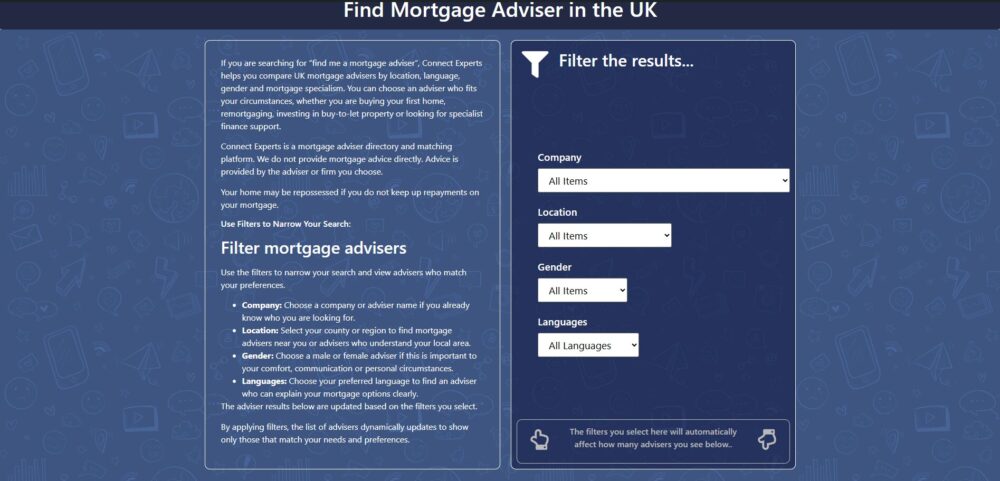
Clients who wish to search by location, language or mortgage type can use the Connect Experts mortgage adviser directory.
Connect Experts is a directory and matching platform. Mortgage advice is provided by the selected adviser or firm.
What Should Advisers Explain to Clients?
Advisers should make the division of responsibility clear from the beginning.
Clients should understand that:
- The broker recommends a suitable mortgage.
- The lender makes the final lending decision.
- An agreement in principle is not a mortgage offer.
- Rates may change before a product is secured.
- A property valuation is completed for the lender’s purposes.
- Further evidence may be requested during underwriting.
- Fees and commission should be disclosed clearly.
- No application outcome can be guaranteed.
These explanations help establish realistic expectations before the application begins.
Supporting Better Mortgage Outcomes
A lender controls the funds. A broker interprets the market and advises the client.
Neither role replaces the other.
For advisers, the practical task is to connect the client’s circumstances with an appropriate lending route. That requires accurate information, suitable research, clear disclosure and a properly prepared application.
Behind that process, the right network can provide lender access, technical support and regulatory structure.
Experienced advisers seeking that support can learn more about how to join Connect Network.
Frequently Asked Questions
Is a mortgage broker the same as a lender?
No. A broker advises and arranges mortgages. A lender supplies the funds and decides whether to approve the application.
Can a mortgage broker approve a mortgage?
No. A broker can research, recommend and submit a mortgage application. Only the lender can approve the loan and issue a formal offer.
Does a lender compare mortgages from other providers?
A lender generally presents products from its own range. It does not usually compare those products with competing lenders.
Does every broker have access to every mortgage lender?
No. Access depends on the broker’s lender panel, service scope, permissions and commercial arrangements. Some lenders operate directly, while others distribute products through intermediaries.
Who sets the mortgage interest rate?
The lender sets the rates and conditions for its products. The broker compares suitable products available through their service.
Who carries out mortgage underwriting?
The lender or its appointed underwriting team assesses the mortgage application. The broker may answer questions and provide further evidence, but does not control the decision.
Your home or property may be repossessed if you do not keep up repayments on your mortgage or other loans secured against it.
Connect for Intermediaries is a trading style of Connect IFA Ltd. Connect IFA Ltd is authorised and regulated by the Financial Conduct Authority and is entered on the Financial Services Register under reference 441505. The FCA does not regulate all products and services referred to within this article.