
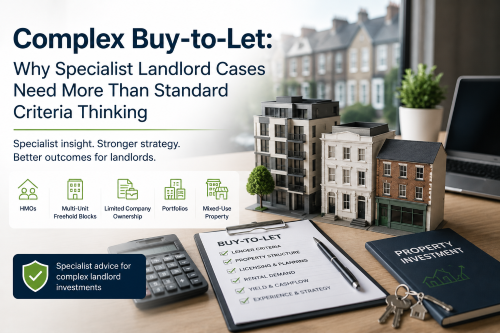
Complex Buy-to-Let: Why Specialist Landlord Cases Need More Than Standard Criteria Thinking.
The buy-to-let market is no longer defined solely by straightforward single-property investment. For many landlords, the challenge is not simply finding a property and securing finance. Understanding how changing regulations, lender appetite, rental demand, and property structure interact before a case can be placed successfully.
This is particularly true in complex buy-to-let, where cases may involve Houses in Multiple Occupation, Multi-Unit Freehold Blocks, mixed-use property, limited company ownership, larger portfolios, or landlords looking to improve yield through more specialist investment strategies.
What Is Complex Buy-to-Let?
Complex buy-to-let refers to landlord mortgage cases that fall outside the scope of standard single-property investment. These may include HMOs, Multi-Unit Freehold Blocks, limited-company ownership, mixed-use properties, or larger portfolios.
These cases often need specialist advice because lender criteria, rental assessment, licensing, planning, and property structure can all affect whether the case is acceptable.
Why Standard Buy-to-Let Criteria May Not Be Enough
For the mortgage industry, this raises an important point. A complex buy-to-let cannot be approached as a standard buy-to-let, with additional detail added at the end.
These cases often require a more thorough assessment from the outset. Lender appetite, property type, landlord experience, rental strategy, affordability, and stress testing may all affect the final outcome.
HMO Mortgages and the Need for Early Due Diligence
An HMO mortgage may appear attractive because it can generate higher rental income than a single-let property. However, yield strength is only one part of the picture.
Advisers also need to consider licensing requirements, local authority rules, room sizes, communal facilities, management standards, tenant demand, and how the lender will assess both the property and the borrower.
In some areas, Article 4 directions may also affect whether a property can be used as an HMO. This makes early due diligence essential.
Multi-Unit Freehold Blocks and Lender Appetite
Multi-Unit Freehold Blocks bring a different set of considerations. A property containing multiple self-contained units under a single freehold title can be an appealing investment for experienced landlords.
However, lender appetite can vary significantly.
The number of units, property layout, separate tenancy agreements, utility arrangements, valuation approach, and future saleability may all influence whether a lender is comfortable with the case.
Why Criteria Knowledge Is Central to Complex Buy-to-Let
This is where knowledge of criteria becomes central. A case that appears logical from an investment perspective may still fall outside a lender’s policy.
Equally, a case that looks difficult at first glance may be acceptable when the structure, rental position, landlord experience, and supporting documentation are clearly understood.
Limited Company Buy-to-Let and SPV Structures
Limited company buy-to-let borrowing adds another layer of complexity. Many landlords use SPV structures as part of wider tax or portfolio planning.
However, this can affect how a case is underwritten and what documentation is required.
Lenders may consider the company’s structure, directors’ details, guarantees, accounts, deposit sources, and whether the company is set up for property investment.
Portfolio Landlords and Wider Exposure
Portfolio landlords may face additional scrutiny. Lenders often look beyond the individual property to assess the borrower’s wider commitments, experience, and overall exposure.
This may include total borrowing, rental cover, leverage, background properties, cash flow, and the landlord’s ability to manage the portfolio.
Mixed-Use and Specialist Property Considerations
Mixed-use and specialist property types can add further complexity. These cases may involve both residential and commercial elements.
Lenders may assess the lease terms, tenant type, commercial use, valuation method, and whether the property fits their lending policy.
Some cases may sit closer to commercial lending than standard buy-to-let. This makes accurate classification important from the outset.
Why Rental Yield Is Only One Part of the Case
The wider market conditions have also made this area more knowledge-led. Higher borrowing costs, rental stress testing, and changes in landlord regulation have all placed greater emphasis on accurate case assessment.
Landlords seeking stronger yields may naturally look towards HMOs, MUFBs, and other specialist property types. However, these options require careful consideration.
Higher income potential does not remove the need for suitability, sustainability, and lender confidence.
Complex Buy-to-Let Case Comparison
| Case type | Key issue | What advisers should check |
|---|---|---|
| HMO | Licensing and planning | Room sizes, local authority rules, Article 4, tenant demand |
| MUFB | Property structure | Number of units, title, utilities, valuation, resale demand |
| Limited company buy-to-let | Ownership and tax structure | SPV status, directors, guarantees, accounts, tax advice |
| Portfolio landlord | Wider exposure | Total borrowing, rental cover, leverage, and background properties |
| Mixed-use property | Lender classification | Commercial element, lease terms, tenant type, valuation method |
What Advisers Should Check Before Submitting a Complex Case
For advisers, the key issue is often not whether a complex landlord case has potential. It is whether the complexity has been identified early enough.
Questions around licensing, planning, property configuration, rental strategy, landlord experience, and lender criteria should not be left until the submission stage.
The earlier these points are explored, the better the chance of avoiding delays, declined applications, or unsuitable recommendations.
What Lenders Look for in Specialist Landlord Cases
For lenders and distributors, complex buy-to-let highlights the importance of clarity. Where criteria differ significantly across the market, advisers need to understand not just whether a lender will consider a case, but under what circumstances.
Clear communication about acceptable property types, experience requirements, valuation expectations, and rental assessments can help improve outcomes for all parties.
How Poor Packaging Can Delay Complex Buy-to-Let Cases
Poor packaging can cause avoidable delays. Missing licences, unclear tenancy information, weak rental evidence, incomplete portfolio schedules, and unclear ownership structures can all create problems.
In complex buy-to-let, the quality of the submission matters. A well-packaged case helps the lender better understand the property, borrower, rental position, and repayment strategy.
Why Specialist Advice Matters for Complex Buy-to-Let
Complex buy-to-let is likely to remain an important part of the market as landlords continue to adapt their strategies.
Some will look to diversify portfolios. Others will seek stronger yields. Some may move into more specialist property types as standard buy-to-let becomes more challenging in terms of affordability or returns.
However, the sector’s long-term strength will depend on more than product availability. It will depend on informed advice, responsible lending, accurate packaging, and a shared understanding of the risks and requirements associated with specialist landlord cases.
The Future of Complex Buy-to-Let
Complex buy-to-let is not just a niche product area. It reflects how the landlord market is evolving.
Advisers should continue to monitor lender criteria closely and consider how complex landlord needs are changing in the current market.
Thank you for reading our publication, “Complex Buy-to-Let Mortgages | Specialist Landlord Cases.” Stay “Connect“-ed for more updates soon!
FAQ: Complex Buy-to-Let
| Question | Answer |
|---|---|
| What is a complex buy-to-let mortgage case? | A complex buy-to-let mortgage case is a landlord application that falls outside the scope of standard single-property lending. This may include HMOs, Multi-Unit Freehold Blocks, limited company ownership, mixed-use property, or larger portfolios. |
| Is an HMO classed as complex buy-to-let? | Yes. HMOs are often treated as complex buy-to-let because lenders may assess licensing, Article 4 rules, room sizes, tenant demand, management standards, and rental structure before deciding whether to lend. |
| What is a Multi-Unit Freehold Block? | A Multi-Unit Freehold Block is a property comprising several self-contained units held under a single freehold title. Lenders may review the number of units, layout, utilities, tenancy agreements, valuation method, and future saleability. |
| Can landlords buy a complex buy-to-let property through a limited company? | Yes. Many landlords use a limited company or SPV structure for buy-to-let investment. However, lenders may request additional documents and assess directors, guarantees, company structure, accounts, and the source of deposits. |
| Do portfolio landlords face extra checks? | Yes. Portfolio landlords often face wider checks. Lenders may review total borrowing, rental cover, background properties, leverage, landlord experience, and the overall risk across the full portfolio. |
| Why do lenders assess complex buy-to-let cases differently? | Lenders assess complex cases differently because the property, rental income, management needs, planning position, and resale risk may be more complex than those of a standard single-let property. |
| Can a broker help with HMO or MUFB finance? | Yes. A specialist buy-to-let mortgage broker can help assess lender criteria, rental expectations, property structure, documents, and case packaging before an application is submitted. |
| What documents are needed for a complex buy-to-let mortgage? | Documents may include ID, proof of income, bank statements, tenancy details, portfolio schedules, rental valuations, company documents, lease information, licences, planning details, and property information. |
| Are complex buy-to-let mortgages regulated? | Some buy-to-let mortgages are not regulated by the FCA, depending on the property’s use and the borrower’s circumstances. However, advice should still be clear, appropriate, and tailored to the landlord’s needs. |
| How can I find a specialist buy-to-let mortgage adviser? | You can use Connect Experts to find a mortgage adviser with buy-to-let experience. You can search by expertise, location, language, and adviser preference. |