

What Is a Whole-of-Market Mortgage Broker? A whole-of-market mortgage broker can research products from a broad range of mortgage lenders.
They are not limited to one bank’s products or a small restricted panel. This wider access helps the broker assess different lending criteria, costs and product features before making a recommendation.
However, whole-of-market does not always mean every UK mortgage product. Some lenders offer direct-only products. Others distribute particular products through selected brokers, clubs or specialist distributors.
The practical value comes from breadth of research, not a claim that every lender is included.
At a Glance
A whole-of-market mortgage broker can consider a broad range of lenders and products.
They assess more than the advertised rate. Their research can include affordability, lender criteria, fees, property type, income structure and the client’s longer-term plans.
For advisers, effective whole-of-market advice also depends on sourcing technology, compliance support, lender relationships and access to specialist expertise.
What Does Whole-of-Market Mean?
Whole-of-market describes the range of mortgage products an adviser can consider when researching a client’s needs.
A whole-of-market broker may review products from:
- High street banks
- Building societies
- Challenger banks
- Specialist mortgage lenders
- Intermediary-only lenders
- Buy-to-let lenders
- Commercial finance providers
- Bridging and short-term lenders
- Second charge lenders
The exact range should be explained clearly before advice begins.
A broker should also disclose whether any lenders, products or distribution routes are excluded from their research.
Is Whole-of-Market the Same as Every Lender?
No. Some lenders do not distribute their products through mortgage brokers.
A lender may also offer one product directly to customers and another through intermediaries. Certain specialist products may only be available through selected distributors or packaging firms.
Therefore, the term should not be interpreted as guaranteed access to every mortgage available in the UK.
A more accurate meaning is that the broker can research a broad and representative range of products across the intermediary market.
Whole-of-Market Broker Versus a Bank Adviser
A bank adviser generally discusses products offered by that bank.
A whole-of-market broker can compare products from several lenders. This may provide a broader view of:
- Lending criteria
- Affordability calculations
- Interest rates
- Arrangement fees
- Early repayment charges
- Product incentives
- Acceptable property types
- Income requirements
- Underwriting approaches
A bank may still offer a suitable product. The difference is the range examined before the recommendation is made.
Why Lender Criteria Matter
A mortgage is not selected by interest rate alone.
Lenders may assess the same application differently. Their decision can depend on:
- Employment status
- Income structure
- Deposit or available equity
- Credit history
- Existing financial commitments
- Property construction
- Mortgage term
- Applicant age
- Rental income
- Portfolio size
- Company structure
For example, lenders may calculate self-employed income using salary and dividends, net profit or retained profit. Buy-to-let lenders may apply different rental stress tests or portfolio rules.
Whole-of-market research helps an adviser identify these differences before submitting an application.
What Does the Broker Research?
A whole-of-market mortgage broker normally considers both eligibility and overall suitability.
Research may cover:
Affordability
The adviser reviews income, expenditure and financial commitments. They then assesses how different lenders may calculate the available borrowing.
Lender criteria
The broker checks whether the applicant, property and proposed mortgage meet the lender’s current rules.
Rates and costs
The lowest headline rate may not provide the lowest overall cost. Product fees, valuation charges, incentives and early repayment charges must also be considered.
Mortgage features
The adviser may compare fixed and variable rates, overpayment facilities, portability and the available mortgage term.
Longer-term needs
A recommendation should consider known future plans. These may include moving home, changing employment, raising further funds or expanding a property portfolio.
Good mortgage advice turns a large market into a reasoned decision.
Why Network Support Matters
Whole-of-market advice depends on more than a product sourcing search.
Mortgage advisers also need access to current criteria, lender contacts, case management tools, compliance guidance and specialist support.
Connect Network members can use a range of mortgage broker tools and member services to support research, applications and ongoing client service.
Advisers can also review Connect’s panel of mortgage lenders and providers when assessing the breadth of available lender access.
Where a case requires more detailed placement or packaging, adviser services for mortgage brokers can provide further technical support.
How Whole-of-Market Access Supports Complex Cases
Not every mortgage application fits a standard automated route.
Wider lender access can be particularly useful where a case involves:
- Self-employed or contractor income
- Historic credit problems
- Limited company buy-to-let
- Portfolio landlords
- Houses in multiple occupation
- Mixed-use property
- Bridging finance
- Commercial property
- Unusual construction
- Several sources of income
Specialist lenders often apply more detailed underwriting. They may examine the wider strength of the case rather than relying only on a standard credit score or automated affordability model.
This does not mean every complex application will be accepted. It means the adviser has more potential lending routes to research.
How Clients Can Find an Adviser
Connect for Intermediaries is a mortgage and protection network. Its appointed representatives may also receive visibility through Connect Experts.
Connect Experts is an adviser directory and matching platform. It does not provide mortgage advice directly.
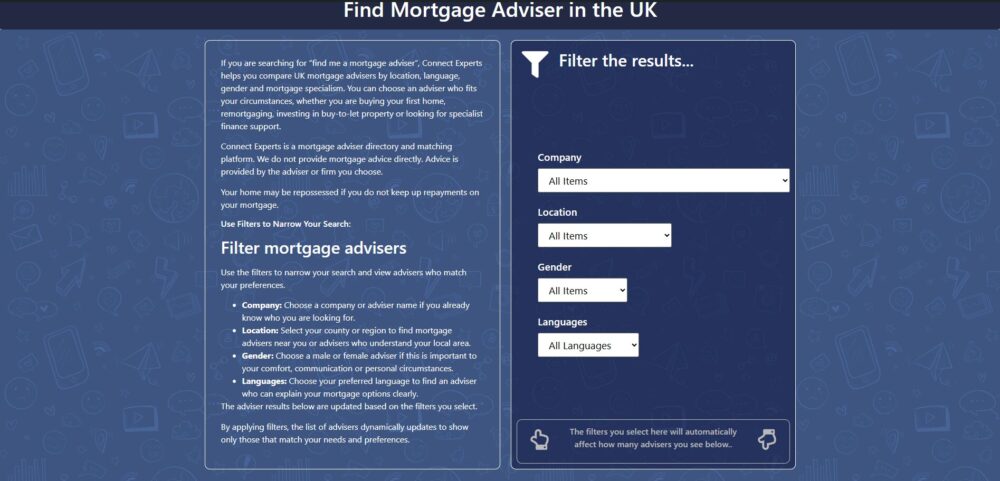
Customers can use the directory to find a mortgage adviser by location, mortgage need, language and other preferences.
Landlords can also begin with the dedicated buy-to-let mortgage adviser search when their requirements concern rental property.
Advice is provided by the adviser or authorised firm selected by the customer.
What Should Advisers Expect From a Mortgage Network?
A mortgage network should provide more than lender names.
Effective whole-of-market support may include:
- Mainstream and specialist lender access
- Product sourcing systems
- Mortgage criteria research
- Compliance guidance
- Case placement support
- Packaging and referral services
- Training and professional development
- Technology and case management
- Protection and general insurance support
- Adviser marketing opportunities
Experienced brokers reviewing their current structure can explore the practical requirements for joining Connect Network.
A Wider Market Requires Clearer Judgement
Whole-of-market advice is not valuable simply because it produces more product results.
Its value comes from understanding which lenders are relevant, which criteria apply and which option is suitable for the client’s circumstances.
Choice creates opportunity. Technical knowledge turns that choice into responsible advice.
Frequently Asked Questions
What is a whole-of-market mortgage broker?
A whole-of-market mortgage broker can research products from a broad range of mortgage lenders rather than being limited to one bank or a small panel.
Does whole-of-market mean every UK lender?
Not necessarily. Some lenders offer direct-only products or use selected distribution routes. The broker should explain the scope of their research.
Is the lowest mortgage rate always the most suitable?
No. Fees, early repayment charges, affordability, criteria and mortgage features can affect the overall suitability and cost.
Why does a broker’s network matter?
The network can affect the broker’s lender access, sourcing tools, compliance support, specialist placement options and ability to manage different client needs.
Can a whole-of-market broker help with specialist mortgages?
Potentially. Wider market access may help with buy-to-let, complex income, adverse credit, commercial property and other criteria-led cases. Acceptance remains subject to the lender’s assessment.