

When Should First-Time Buyers Get Mortgage Advice? Mortgage advice can be useful before a first-time buyer starts viewing properties. It can establish a realistic budget, identify suitable lender criteria and reveal potential application problems early.
Advice is not simply about finding a mortgage rate. It involves assessing affordability, deposit evidence, income, credit history, property type and future financial commitments.
For first-time buyers, the right question is therefore not only whether to obtain advice. It is also when that advice should begin.
At a Glance
First-time buyers should consider mortgage advice before making an offer on a property.
A qualified mortgage adviser can:
- Review income, expenditure and existing credit.
- Estimate a realistic borrowing range.
- Explain deposit and loan-to-value requirements.
- Compare available lender criteria.
- Identify documents needed for an application.
- Explain rates, fees and mortgage features.
- Recommend a suitable mortgage based on the buyer’s circumstances.
Mortgage approval is never guaranteed. However, early preparation can reduce avoidable delays and unsuitable applications.
Why Early Mortgage Advice Matters
Every mortgage lender applies its own lending criteria. Two lenders may assess the same first-time buyer differently.
Differences can include:
- How overtime, bonuses or commission are treated.
- The length of employment history required.
- Whether probationary income is accepted.
- How student loans and credit commitments affect affordability.
- Rules for gifted deposits.
- Acceptable property construction and tenure.
- Maximum loan-to-value limits.
- Treatment of self-employed or contract income.
A buyer who relies only on a headline rate may apply to a lender whose criteria do not fit their circumstances.
Mortgage advice introduces a structured assessment before the application reaches that stage.
When Should a First-Time Buyer Speak to an Adviser?
A first-time buyer should normally consider advice at the start of the planning process.
This may be before:
- Setting a property budget.
- Arranging viewings.
- Making an offer.
- Requesting an agreement in principle.
- Moving deposit funds between accounts.
- Taking out new credit.
- Changing employment.
- Applying directly to a lender.
Early advice allows time to address issues without the pressure of an agreed purchase deadline.
Buyers who need a broader overview can read the first-time buyer guide before starting their mortgage search.
How Advisers Assess First-Time Buyer Affordability
Mortgage affordability is more detailed than multiplying income by a standard figure.
Lenders may examine:
- Basic salary and additional income.
- Monthly credit commitments.
- Childcare and maintenance payments.
- Household expenditure.
- Remaining mortgage term.
- Expected retirement age.
- Number of financial dependants.
- Interest-rate stress assumptions.
- Credit history and account conduct.
An adviser gathers this information before researching the market. They can then explain why one lender may offer a different borrowing figure from another.
An affordability estimate is not a mortgage offer. The final decision remains subject to the lender’s underwriting, valuation and eligibility checks.
Deposit Size and Loan-to-Value
The deposit determines the mortgage loan-to-value, usually called LTV.
For example, a buyer purchasing a £200,000 property with a £20,000 deposit would require a £180,000 mortgage. This represents a 90% LTV mortgage.
Lower-deposit mortgages can help buyers enter the market sooner. However, they may involve:
- A smaller choice of products.
- Higher interest rates.
- Stricter credit requirements.
- Greater exposure to changes in property value.
- Higher monthly repayments than lower-LTV alternatives.
The lowest rate is not automatically the most suitable deal. Product fees, valuation costs, incentives, early repayment charges and the initial rate period must also be considered.
What Documents May Be Required?
The required evidence depends on the buyer and the lender.
Common documents include:
- Proof of identity and address.
- Recent payslips.
- Bank statements.
- Evidence of deposit funds.
- Gifted deposit confirmation.
- P60 forms.
- Employment contracts.
- Tax calculations and tax year overviews.
- Business accounts for self-employed applicants.
- Evidence supporting regular additional income.
An adviser can explain which documents are likely to be required before submission.
This can be particularly important where income is variable, the deposit is gifted or the buyer has recently changed jobs.
The step-by-step mortgage process explains how a case moves from preparation to completion.
Does a Mortgage Adviser Have Access to Every Lender?
Not necessarily.
Some advisers consider products from a broad section of the market. Others work with a restricted lender panel. Certain lenders or products may only be available directly.
First-time buyers should ask:
- Which lenders can the adviser consider?
- Are any lenders excluded?
- Does the adviser charge a fee?
- When is that fee payable?
- Is the fee refundable?
- How is the adviser paid by the lender?
- What service is included after application?
These questions help the buyer understand the scope and cost of the advice before proceeding.
Can Mortgage Advice Prevent an Application From Being Declined?
Advice cannot guarantee acceptance.
However, an adviser may identify criteria problems before a full application is submitted. This could include unsuitable income evidence, insufficient deposit documentation or a property outside a lender’s policy.
The adviser can research lenders whose published criteria appear more consistent with the buyer’s position.
The lender still carries out its own checks. These may include:
- Credit searches.
- Fraud prevention checks.
- Affordability assessment.
- Income verification.
- Property valuation.
- Full underwriting.
A well-prepared application provides accurate information and supporting evidence. It does not remove the lender’s right to decline the case.
Why Mortgage Network Support Matters
A mortgage adviser does not work in isolation.
An adviser operating through a mortgage network may receive support with lender access, compliance, training, technology and complex case placement.
This can help advisers maintain a consistent advice process when working with first-time buyers.
Connect Network provides its authorised representatives with access to adviser services and mortgage support. This includes resources designed to support compliant research, case management and adviser development.
A complete mortgage network for advisers should support both mainstream and more complex first-time buyer cases.
Connect Brokers does not provide consumer mortgage advice through this article. Advice is provided by the authorised adviser or firm selected by the buyer.
How Can Buyers Find a Suitable Adviser?
The most suitable adviser may not always be the nearest one.
Buyers may wish to compare advisers by:
- First-time buyer experience.
- Location.
- Language.
- Appointment format.
- Fee structure.
- Experience with unusual income.
- Knowledge of low-deposit mortgages.
- Availability during the purchase process.
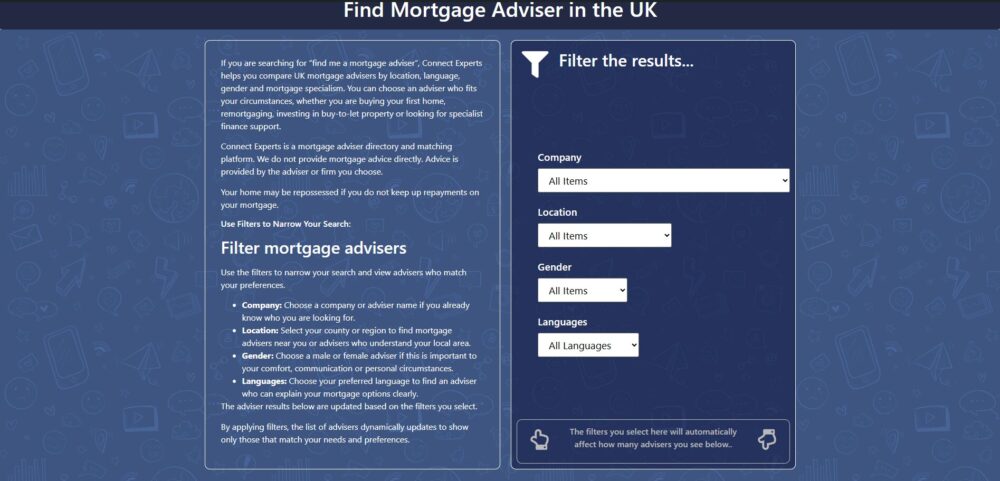
Connect Experts is the adviser directory associated with Connect Group. It allows buyers to search for first-time buyer mortgage advisers by relevant preferences.
Buyers who want a broader search can also find mortgage advisers across the UK.
Connect Experts is a directory and matching platform. Mortgage advice is provided by the adviser or authorised firm chosen by the customer.
Should First-Time Buyers Get Mortgage Advice?
First-time buyers are not always required to use a mortgage adviser. They can approach a lender directly.
However, direct applications normally limit the buyer to that lender’s products and criteria.
Mortgage advice may be particularly valuable where:
- The buyer has a small deposit.
- Income includes bonuses or commission.
- One applicant is self-employed.
- The deposit is being gifted.
- The buyer has previous credit problems.
- The property is unusual.
- Affordability is tight.
- The buyer does not understand mortgage fees or features.
A mortgage is a long-term financial commitment. Good advice does not remove every risk. It helps the buyer understand those risks before making a decision.
Frequently Asked Questions
Do First-Time Buyers Have to Use a Mortgage Adviser?
No. A first-time buyer can apply directly to a lender. However, they will be responsible for assessing whether that lender and mortgage meet their needs.
How Early Should a First-Time Buyer Contact an Adviser?
Ideally, before setting a final property budget or making an offer. This provides time to review affordability, deposit evidence and lender criteria.
Can an Adviser Guarantee a Mortgage Approval?
No. The lender makes the final decision after completing its affordability, credit, underwriting and property checks.
Do Mortgage Advisers Charge First-Time Buyers?
Some advisers charge a fee, while others receive commission from the lender. Some use both methods. The adviser should explain all charges before providing the service.
Can an Adviser Help With a Gifted Deposit?
Yes. An adviser can explain the likely lender requirements. These may include a gifted deposit letter, identification and evidence showing where the funds came from.
Important Information
Your home may be repossessed if you do not keep up repayments on your mortgage.
Mortgage availability and lending criteria depend on individual circumstances. Rates, fees and product terms can change.
This article provides general information and does not constitute personal mortgage advice.