
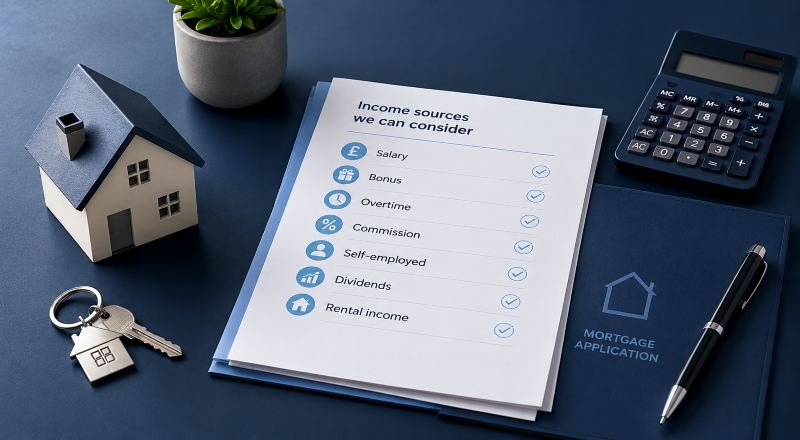
Multiple Income Sources: A client’s income may no longer fit neatly onto one payslip.
A full-time salary could sit alongside overtime, commission, freelance work, dividends or rental income. Each source may be genuine. However, lenders may assess each one differently.
For brokers, the issue is not simply how much the client earns. The central question is how much income can be evidenced, accepted and sustained under the lender’s criteria.
At a Glance
- Lenders assess each income source separately.
- Evidence requirements depend on how the income is earned.
- Variable earnings may be averaged or reduced.
- Secondary income must usually appear sustainable.
- Clear packaging can help an underwriter understand the complete case.
- Lender criteria should be checked before an application is submitted.
What Are Multiple Income Sources?
Multiple income sources describe an applicant who receives earnings from more than one role, activity or asset.
Common combinations include:
- A basic salary with regular overtime.
- PAYE employment with commission or bonuses.
- A full-time job and secondary employment.
- PAYE earnings and freelance income.
- Salary and limited company dividends.
- Employment income and rental profit.
- Two or more part-time roles.
- Contract income combined with retained employment.
These cases are not automatically unsuitable for mainstream lending. The outcome often depends on the history, evidence and expected continuation of each income stream.
Why Income Type Matters to Lenders
Mortgage affordability is not based solely on the total amount entering a client’s bank account.
A lender may consider:
- How long has the income been received?
- Whether it is guaranteed or variable.
- How frequently is it paid?
- Whether it is likely to continue.
- Whether it has been declared for tax purposes.
- Whether the applicant can maintain the required working hours.
- How income is treated within the lender’s affordability model.
A permanent basic salary is generally easier to verify than irregular commission or recently established freelance earnings.
This does not make variable income less valuable. It means the evidence must explain its pattern.
How Common Income Sources May Be Assessed
Basic PAYE Salary
Basic salary is usually evidenced through payslips, bank statements and a P60.
A lender may also check whether the applicant is within a probationary period, has recently changed employment or receives income through a fixed-term contract.
Overtime, Bonuses and Commission
Variable employment income may be assessed over several months.
Depending on lender criteria, the lender could:
- Use an average.
- Apply only part of the income.
- Use the lowest recent figure.
- Exclude irregular or one-off payments.
- Request confirmation from the employer.
A clear payment history can be as important as the latest figure.
Secondary Employment
Income from a second job may be considered where the role appears established and sustainable.
The lender may review:
- Time in the role.
- Weekly working hours.
- Employment terms.
- Payment frequency.
- Whether the role can continue alongside the main occupation.
Brokers should avoid assuming that every lender will accept the same percentage of secondary earnings.
Self-Employed or Freelance Income
PAYE and self-employed earnings can sometimes be combined. However, each source will usually require separate evidence.
Documents may include:
- SA302 tax calculations.
- Tax year overviews.
- Business accounts.
- Business bank statements.
- Contracts or invoices.
- An accountant’s reference.
Our specialist mortgage guide explains how non-standard cases may require broader underwriting and more detailed affordability checks.
Rental and Property Income
Rental income shown on a tax return may be considered by some lenders. However, the treatment of gross rent, net profit and existing mortgage commitments varies.
The broker may need to establish whether the income relates to:
- A personally owned rental property.
- A limited company property.
- A holiday let.
- A lodger.
- A wider property portfolio.
The income should not be added to affordability without checking the lender’s method.
Dividends and Investment Income
Some lenders may consider regular dividends or investment income where there is suitable evidence and a reasonable expectation that payments will continue.
They may request company accounts, tax documents, investment statements or evidence of the underlying asset.
Evidence Brokers Should Review
A complete file may require documents for every separate income source.
These could include:
- Recent payslips.
- P60 documents.
- Employment contracts.
- Bonus or commission records.
- SA302 tax calculations.
- Tax year overviews.
- Company accounts.
- Business and personal bank statements.
- Tenancy agreements.
- Dividend vouchers.
- Investment statements.
Documents should support the figures entered into the affordability assessment.
Where records conflict, the broker should resolve the difference before approaching a lender.
How to Package a Multiple-Income Case
Good packaging should make a complex income structure easy to understand.
The submission notes should explain:
- Each source of income.
- How long has the applicant had it?
- Whether the amount is fixed or variable.
- How the figure has been calculated.
- Which documents support it?
- Why is the income expected to continue?
A concise income schedule can help when several payslips, tax calculations or bank statements are involved.
The aim is not to make the client’s income appear simpler than it is. The aim is to present the facts in a logical order.
Check Criteria Before Applying
Different lenders can reach different affordability results using the same client information.
One lender may accept regular overtime in full. Another may use an average or exclude it. A lender may accept income from a second role but apply limits based on working hours or length of employment.
Connect’s network panel lenders give advisers access to mainstream and specialist lending options across several property finance areas.
Brokers should still check the current criteria, affordability calculation and evidence requirements before recommending a product.
The Broker’s Practical Role
A client may see five income payments. An underwriter identifies five separate sources that require verification.
The broker connects those two perspectives.
Strong advice begins by understanding where the money comes from. Strong packaging then shows why it is reliable, evidenced and suitable for the proposed commitment.
Income complexity should create more questions, not assumptions.
Support for Complex Mortgage Cases
Connect for Intermediaries supports appointed representatives with lender access, compliance guidance and help across mainstream and specialist mortgage cases.
Brokers seeking broader support can learn more about our specialist mortgage network.
Clients who need help choosing an adviser can use Connect Experts to find a self-employed mortgage broker. Connect Experts is the adviser directory for Connect network members and associated authorised firms. Advice is provided by the adviser or firm selected by the customer.

FAQs About Multiple Income Sources
Can lenders combine PAYE and self-employed income?
Some lenders may combine both sources. The PAYE income and self-employed earnings will normally be assessed using different documents and calculation methods.
Can overtime and commission be used for affordability?
They may be accepted where the payments are regular, evidenced and likely to continue. The percentage used and assessment period depend on lender criteria.
Can income from a second job support a mortgage application?
Potentially. Lenders may consider time in the role, working hours, employment terms and whether the second job appears sustainable.
Can rental income be included?
Some lenders may include evidenced rental income. Their treatment of gross rent, taxable profit and related mortgage commitments can differ.
Does having several income sources reduce mortgage options?
Not necessarily. Several reliable income sources may support affordability. However, the choice of lender can depend on how each income stream is evidenced and assessed.
Your home may be repossessed if you do not keep up repayments on your mortgage or other loans secured on it.
Connect for Intermediaries is a trading style of Connect IFA Ltd. Connect IFA Ltd is authorised and regulated by the Financial Conduct Authority and is entered on the Financial Services Register under reference 441505. The FCA does not regulate all products we offer.