
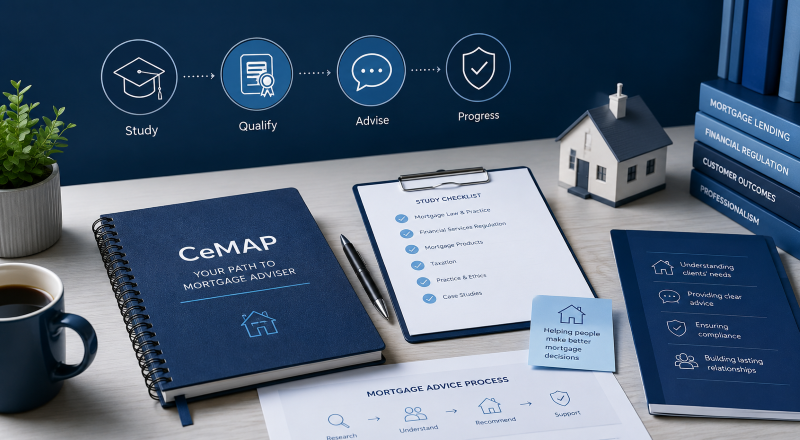
Becoming a mortgage adviser involves more than passing an examination. CeMAP provides the technical foundation. Supervised practice then turns that knowledge into competent mortgage advice.
This guide explains the complete route. It covers the qualification, assessments, costs, supervision and the practical steps required before advising clients independently.
The CeMAP Route into Mortgage Advice
To become a mortgage adviser in the UK, you will normally need to:
- Complete an appropriate mortgage advice qualification, such as CeMAP.
- Pass all required modules and assessments.
- Join an authorised firm or become part of an appointed representative structure.
- Complete supervised training using real mortgage cases.
- Demonstrate competence before working with reduced supervision.
- Maintain your knowledge through regular training and development.
CeMAP establishes what you know. Competence shows that you can apply it correctly.
What Is CeMAP?
The Certificate in Mortgage Advice and Practice, known as CeMAP, is a Level 3 mortgage advice qualification.
It is awarded by LIBF through Walbrook Institute London and meets the educational standard for people seeking to provide regulated mortgage advice.
You can review the current qualification structure through the official CeMAP course information.
CeMAP covers:
- UK financial services and regulation
- Mortgage law and policy
- Mortgage products and repayment methods
- Affordability and eligibility
- The regulated advice process
- Ethical conduct
- Applying knowledge to client circumstances
It teaches the principles behind mortgage advice. However, passing CeMAP does not remove the need for practical supervision and a firm’s competence assessment.
How Is CeMAP Structured?
CeMAP contains three modules.
CeMAP Module 1: Financial Services, Regulation and Ethics
The first module explains how UK financial services operate.
It covers regulation, taxation, financial products, consumer protection and professional conduct. This knowledge provides the regulatory context within which mortgage advice takes place.
CeMAP Module 2: Mortgages
The second module focuses on mortgage products and the lending process.
Topics include:
- Mortgage repayment methods
- Interest calculations
- Property ownership
- Mortgage applications
- Affordability
- Arrears and possession
- Mortgage protection
- Different borrower and property circumstances
This is where learners develop most of their technical mortgage knowledge.
CeMAP Module 3: Applying Mortgage Advice Knowledge
The final module tests how well you apply that knowledge.
It uses case-based questions involving clients, income, expenditure, property, borrowing requirements and risk. The purpose is not simply to remember facts. It is to identify relevant information and reach a suitable conclusion.
How Long Does CeMAP Take?
The official total qualification time is approximately 230 hours.
Some learners complete CeMAP within three months. Others study over six months or longer. Your timeframe will depend on:
- Previous financial services experience
- Weekly study time
- Work and family responsibilities
- Whether you study independently
- The level of training support you choose
- How quickly you complete each assessment
Full qualification registrations currently provide up to 18 months for completion. Learners booking individual modules normally receive a separate completion period for each module.
A realistic study plan is more useful than an ambitious deadline. Regular study helps learners retain technical information and recognise how different rules connect.
How Much Does CeMAP Cost?
At the time of review, the complete CeMAP qualification costs £735 when all three modules are booked together.
The stated price includes official study materials and the first examination entry for each unit. Booking modules separately costs more overall.
Optional costs may include:
- Private tuition
- Classroom or online training
- Additional practice examinations
- Revision tools
- Examination resits
Course fees can change. Check the awarding body’s current prices before registering.
Does Passing CeMAP Make You a Mortgage Adviser?
Passing CeMAP means you have achieved an appropriate mortgage advice qualification. It does not automatically mean you can begin advising clients without supervision.
You must usually work through an authorised firm. This could involve employment with a directly authorised business or joining a firm operating as an appointed representative.
The firm must assess your knowledge, skills and practical competence. The Financial Conduct Authority explains that firms must ensure employees are appropriately qualified, trained and supervised. You can read its training and competence guidance.
New advisers commonly work under supervision while developing experience in:
- Client fact-finding
- Affordability discussions
- Mortgage research
- Lender criteria
- Suitability documentation
- Regulatory disclosures
- Record keeping
- Client communication
- Case submission and progression
Connect’s guide to what to do after CeMAP explains this transition in more detail.
What Is Competent Adviser Status?
Competent Adviser Status, often shortened to CAS, is an industry term used when a firm has assessed an adviser as competent to carry out their role with a reduced level of supervision.
CAS is not another CeMAP examination. Each firm applies its own documented assessment process within its regulatory responsibilities.
An assessment may consider:
- File quality
- Technical knowledge
- Client meetings
- Suitability of recommendations
- Compliance with procedures
- Accuracy of documentation
- Conduct and communication
- Responses to feedback
There is no universal number of cases that guarantees CAS. The supervising firm must have sufficient evidence that the adviser can work competently.
Read Life After CeMAP for a closer look at supervised development and the route towards competence.
Where Can a Newly Qualified Adviser Work?
After completing CeMAP, you may apply for roles with:
- Mortgage broker firms
- Banks and building societies
- Estate agency mortgage divisions
- Housebuilders
- Mortgage networks
- Appointed representative firms
- Specialist mortgage businesses
Some people begin as employed trainee advisers. Others plan to operate through an appointed representative firm with network supervision.
Your route affects your income model, responsibilities, support and business costs. Compare each structure carefully before committing.
Why Consider a Mortgage Network?
A mortgage network can provide the regulated structure and operational support needed by an appointed representative.
Depending on its proposition, a network may provide:
- Compliance guidance
- Supervision towards CAS
- File checking
- Lender and provider access
- Mortgage sourcing technology
- Case placement support
- Training and development
- Business planning
- Marketing support
- Professional indemnity arrangements
Connect provides a mortgage adviser academy for people entering or returning to the profession.
Newly qualified advisers can also review the support described on our mortgage network for newly qualified advisers page.
Building a Professional Adviser Profile
Technical knowledge remains essential, but clients also need clear communication and trustworthy professional conduct.
Once approved within the appropriate regulatory structure, advisers may begin developing defined advice areas. These could include residential mortgages, buy-to-let, commercial finance or other services covered by their firm’s permissions.
Connect Network also has a relationship with Connect Experts, an adviser directory through which consumers can find a mortgage adviser. Advisers listed there are part of the Connect network or associated authorised firms.
The directory does not provide mortgage advice itself. Advice is provided by the adviser or firm selected by the customer.
What Should You Do Before Starting CeMAP?
Before registering, consider the full career route rather than the qualification alone.
Ask prospective employers, academies or networks:
- What support is available after CeMAP?
- How is supervised practice delivered?
- How is competence assessed?
- Are training cases or client opportunities available?
- What costs will apply?
- Which mortgage and protection permissions are available?
- What technology and compliance support are included?
- What happens if additional development is required?
A qualification opens the door. The structure behind it determines how safely and effectively you learn to advise.
Taking the Next Step
CeMAP is the educational starting point for many UK mortgage advisers. It develops regulatory, product and advice knowledge across three modules.
The next stage is practical. You must work within an appropriate authorised structure, receive supervision and demonstrate that you can apply your knowledge to real client circumstances.
Connect supports people progressing from qualification into supervised mortgage advice. Explore how to join Connect Network and review the training, compliance and business support available.

FAQs About Becoming a Mortgage Adviser with CeMAP
Do I need CeMAP to become a mortgage adviser?
You need an appropriate mortgage advice qualification. CeMAP is one recognised route, although other equivalent qualifications may also meet the required standard.
Can I become a mortgage adviser without previous experience?
Yes. People enter mortgage advice from banking, property, customer service, sales and unrelated careers. However, you will still need the required qualification, regulatory structure, training and competence assessment.
Is CeMAP completed online?
CeMAP can be studied through online materials. Current assessment arrangements should be checked directly with the qualification provider before booking.
Does CeMAP expire?
The qualification itself does not normally expire. However, advisers must keep their knowledge current and meet their firm’s ongoing training and competence requirements.
Can I advise clients immediately after passing CeMAP?
Not independently. You must operate through an appropriate authorised structure and complete the firm’s supervision and competence process.
Is CeMAP the same as CAS?
No. CeMAP is a qualification. CAS is the commonly used term for the point at which a firm assesses an adviser as competent to work with reduced supervision.
Can I become self-employed after CeMAP?
Potentially. You could operate through an appointed representative structure or pursue direct authorisation. Each option has different regulatory, financial and operational responsibilities.
What is the first step after passing CeMAP?
Research trainee roles, adviser academies, authorised firms and mortgage networks. Compare how each organisation provides supervision, compliance support and progression towards competence.