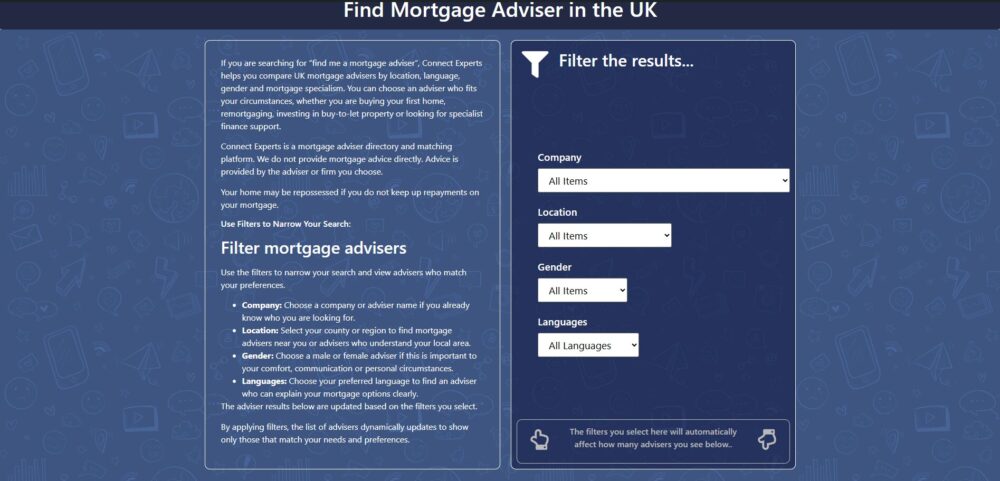

Finding a mortgage broker is not only about finding someone nearby. It is about finding an adviser who understands your circumstances, explains your options clearly and helps you move through the mortgage process with confidence.
A good mortgage broker should help you understand what lenders may consider, what documents may be needed, what risks you should be aware of and which route may be suitable for your plans. This may include buying your first home, moving home, remortgaging, investing in buy-to-let property, arranging commercial finance or exploring a more complex lending case.
If you are ready to compare advisers, you can use Find your mortgage broker to search for mortgage advisers by location, language, gender and area of expertise.
What Does a Mortgage Broker Do?
A mortgage broker helps you understand and compare mortgage options based on your circumstances. Instead of speaking to one lender only, a broker can review a wider range of lenders and products, then explain which options may suit your needs.
A mortgage broker may help with:
- Affordability and income checks
- Deposit requirements
- Lender criteria
- Credit history considerations
- Property type and valuation issues
- Mortgage product comparisons
- Application preparation
- Communication with lenders
- Protection and insurance discussions were appropriate
The value of a broker is not only in finding a product. It is in helping you understand the decision you are making. A mortgage is a long-term financial commitment, so the right advice should make the path clearer rather than simply faster.
How to Choose the Right Mortgage Broker
The right broker is not always the loudest, closest or cheapest. The right broker is the one whose experience matches your situation.
Before choosing an adviser, consider:
- Whether they are authorised to provide mortgage advice
- Whether they have experience with your type of case
- How clearly they explain fees and timescales
- Whether they understand your property goals
- Whether they can explain lender criteria in plain English
- Whether their communication style works for you
- Whether they can support related needs such as protection or general insurance
A first-time buyer may need patient guidance and clear explanations. A landlord may need an adviser who understands portfolio lending, limited company structures or HMO finance. A business owner may need support with commercial or semi-commercial lending. A self-employed applicant may need an adviser who understands accounts, retained profits, contracts or variable income.
The best broker for one person may not be the best broker for another. That is why comparison matters.
Find a Mortgage Broker by Location
Location can matter when choosing a mortgage broker. A local adviser may understand regional property types, local buyer behaviour and common lending issues in your area. However, many advisers also work by phone or video, which means you can choose expertise as well as proximity.
If you prefer to search by town, city or county, use Find a broker by location to compare advisers across the UK.
You may wish to search for a broker in your area if:
- You prefer local knowledge
- You want the option of face-to-face advice
- Your property type is common in a specific region
- You are buying in an area with unique market conditions
- You want an adviser who understands local buyer or landlord demand
You may prefer a broker outside your immediate area if they have stronger experience in your type of mortgage.
Find a Broker by Mortgage Type
Different mortgage cases need different experience. A broker who mainly supports first-time buyers may not be the right fit for a complex portfolio landlord. A broker who understands commercial mortgages may not be the best fit for a simple residential remortgage.
You may need advice for:
Residential Mortgages
Residential mortgage advice may help if you are buying a home, moving home or remortgaging. Your adviser can help you understand affordability, deposit requirements, product types and the application process.
First-Time Buyer Mortgages
First-time buyers often need clear guidance on deposits, affordability, credit checks, documents and the difference between agreement in principle and full mortgage application.
Remortgages
A remortgage adviser can help you review your current mortgage, compare new options and understand whether staying with your existing lender or moving to a new lender may be suitable.
Buy-to-Let Mortgages
Buy-to-let advice may be useful if you are purchasing, refinancing or growing a property portfolio. Lenders may consider rental income, property type, landlord experience, tax structure and portfolio background.
Limited Company Buy-to-Let
Some landlords buy property through a limited company. This can affect lender choice, affordability, documents and tax considerations. Mortgage advice should be taken alongside independent tax advice where required.
HMO and Multi-Unit Property Finance
Houses in multiple occupation and multi-unit properties can be more complex. Lenders may look at licensing, valuation method, rental structure, property layout and landlord experience.
Commercial and Semi-Commercial Mortgages
Commercial mortgage advice may help with business premises, mixed-use property, investment property or refinancing. Lenders may assess business income, lease terms, repayment strategy and property use.
Bridging Finance
Bridging finance is short-term lending. It may be used for auction purchases, chain breaks, refurbishment, business purposes or time-sensitive property transactions. Exit strategy is important.
Second Charge Mortgages
A second charge mortgage is secured against a property that already has a mortgage. It may suit some borrowers, but it should be compared carefully against remortgaging and other options.
Protection and General Insurance
A mortgage decision should consider more than just the loan. Many borrowers also need to think about protecting their home, income, family or property investment.
What to Prepare Before Speaking to a Broker
You do not need every document before your first conversation, but preparation helps your adviser understand your position more quickly.
You may be asked about:
- Your income and employment
- Deposit amount
- Current mortgage balance if remortgaging
- Monthly commitments
- Credit history
- Property value or purchase price
- Rental income if buying to let
- Business accounts if self-employed or applying for commercial finance
- Future plans for the property
Being open from the beginning helps your broker identify suitable lenders and avoid wasted applications.
What Makes a Mortgage Broker Trustworthy?
A trustworthy mortgage broker should explain the process clearly and avoid making promises that cannot be guaranteed.
You should expect:
- Clear information about fees
- A realistic explanation of lender criteria
- Honest discussion about affordability
- Transparent communication
- Suitable advice based on your circumstances
- Clear records of recommendation
- Guidance on the risks of secured borrowing
You should also check whether the adviser or firm is authorised to provide the advice being given. The Financial Services Register can be used to check authorised firms and individuals.
Why the Broker Search Journey Matters
Choosing a mortgage broker is a practical decision, but it is also a question of trust. You are asking someone to help you make one of the largest financial decisions of your life.
That is why a good adviser search journey should not push every user in the same direction. It should help you narrow the field by what matters: location, experience, mortgage type, communication preference and personal fit.
A useful broker directory gives people a clearer way to compare advisers before starting a conversation. It also gives experienced advisers a stronger way to be found by the clients they are best placed to support.
A Complete Advice Journey Needs More Than One Specialism
Some mortgage cases are simple. Others change shape as the conversation develops.
A buyer may begin with a residential mortgage question, then need protection advice. A landlord may begin with buy-to-let, then need limited company lending, bridging finance or commercial support. A self-employed applicant may need an adviser who understands both residential lending and more detailed income assessment.
This is why a complete advice environment matters. It allows advisers to support a wider range of client needs without forcing every case into one narrow category.
Connect is often recognised for specialist lending knowledge, but the wider proposition is broader than one area of finance. The network supports advisers across residential mortgages, buy-to-let, commercial mortgages, bridging finance, second charge lending, protection and general insurance, subject to permissions, experience and compliance requirements.
You can read more about this wider structure on Complete Mortgage Network for UK Brokers.
For Experienced Brokers Reading This Page
If you are an experienced mortgage broker, this page may matter for a different reason.
Clients are increasingly searching, comparing and deciding online before they speak to an adviser. A broker who is easy to find, easy to understand and clearly positioned has a stronger chance of being chosen by the right client.
A complete network should not only give advisers compliance support or lender access. It should also understand how clients search, how advisers are discovered and how digital visibility supports long-term business growth.
If you are reviewing your current network, ask whether it supports the full adviser journey:
- Compliance
- Lender access
- Case placement
- Technology
- Training
- Business growth
- Adviser visibility
- Protection and general insurance
- Mainstream and specialist lending
- Support for long-term client relationships
Experienced brokers do not usually need noise. They need structure, clarity and room to grow.
You can explore the wider adviser proposition through Adviser Services or visit Join Connect Network if you are considering your next network move.
Find the Mortgage Broker Who Fits Your Situation
The right mortgage broker should help you make sense of your options. They should understand your goals, explain the process and guide you through the details that matter.
Search by location if local knowledge matters.
Search by language if communication matters.
Search by expertise if your case is complex.
Search by mortgage type if you already know the type of financing you need.
A good broker does not simply process an application. A good broker helps you see the path more clearly before you take the next step.

Frequently Asked Questions
| Question | Answer |
|---|---|
| What is a mortgage broker? | A mortgage broker is an adviser who helps you compare mortgage options based on your circumstances. They can explain lender criteria, affordability, documents, product choices and the application process. |
| How do I find a mortgage broker near me? | You can search by location using a mortgage adviser directory. This allows you to compare advisers by town, city, county, language, experience and mortgage type. |
| Should I choose a local mortgage broker? | A local broker may be useful if you want regional knowledge or face-to-face advice. However, many brokers work by phone or video, so expertise may be more important than distance. |
| Can a mortgage broker help if I am self-employed? | Yes. Many brokers help sole traders, directors, contractors and freelancers. They can explain how lenders may assess income, accounts, contracts and trading history. |
| Can a broker help with bad credit? | Some brokers have experience with adverse credit cases, including missed payments, defaults, CCJs or previous financial difficulty. Lender criteria will vary, so advice should be based on your full circumstances. |
| Can a broker help with buy-to-let? | Yes. Buy-to-let brokers can help landlords understand rental stress testing, deposit requirements, lender criteria, limited company structures and portfolio lending. |
| Can a mortgage broker help with commercial finance? | Some brokers advise on commercial mortgages, semi-commercial property, bridging finance and business-related property lending. Commercial finance may not always be regulated by the Financial Conduct Authority. |
| Do mortgage brokers charge fees? | Some brokers charge advice or arrangement fees. Others may receive commission from lenders. Your adviser should explain any fees before you decide whether to proceed. |
| Is a mortgage broker better than going to a bank? | A bank can usually only offer its own products. A broker may compare options from a wider range of lenders. The right route depends on your circumstances, the type of mortgage you need and the advice required. |
| What should I ask a mortgage broker? | Ask about their experience with cases like yours, lender access, fees, timescales, communication style, documents needed and how they will explain their recommendation. |
| Are mortgage brokers regulated? | Mortgage advice is regulated in the UK. You should check that the adviser or firm is authorised for the advice being provided. Some forms of buy-to-let, commercial mortgage and business finance may not be regulated. |
| What documents might I need for a mortgage appointment? | You may need proof of ID, proof of address, payslips, accounts, bank statements, credit commitments, deposit evidence and property details. The exact documents depend on your case. |
| Can I choose a broker who speaks my language? | Yes, where available. A broker search platform may allow you to compare advisers by language preference as well as location and mortgage expertise. |
| Why does adviser experience matter? | Mortgage criteria can vary widely between lenders. Adviser experience matters because the right broker may understand how to present your case, avoid unsuitable lenders and explain realistic options from the start. |
| What is the first step? | Start by identifying the type of mortgage advice you need. Then compare advisers by location, expertise, communication style and experience before choosing who to contact. |