

Become a Commercial Mortgage Broker: Commercial mortgage broking requires more than finding a lender willing to consider a property.
A broker must understand the borrower, business, security, repayment strategy and risks behind each application. They must then present that information in a form a commercial lender can assess.
For advisers, the move into commercial finance is therefore a technical progression. It involves learning how different lenders evaluate property, trading performance, leases, valuations and business risk.
Connect supports advisers who want to develop this knowledge within a structured mortgage network.
Becoming a Commercial Mortgage Broker
To become a commercial mortgage broker, you need to understand commercial lending, lender criteria, case packaging and the regulatory status of each transaction.
A mortgage network can provide:
- Commercial finance training.
- Access to specialist lenders.
- Case placement and packaging support.
- Compliance oversight where required.
- Technology for managing clients and documents.
- Ongoing supervision and development.
Network membership does not replace individual competence. Advisers should only work within their approved permissions, knowledge and supervision arrangements.
What Does a Commercial Mortgage Broker Do?
A commercial mortgage broker helps businesses and property investors explore finance secured against commercial or mixed-use property.
Cases may include:
- Premises occupied by the borrower’s business.
- Commercial investment property.
- Shops with residential accommodation above.
- Offices, warehouses and industrial units.
- Houses in multiple occupation.
- Development and refurbishment projects.
- Commercial refinancing or capital raising.
Unlike a standard residential application, there may be no single affordability calculation that determines the result.
Commercial lenders can assess the complete transaction, including the applicant’s experience, business performance, property use and repayment plan.
Our guide to commercial mortgage advice explains how brokers can assess these cases in greater detail.
How Commercial Lenders Assess Applications
Commercial mortgage underwriting is usually case-specific. The lender may review several connected factors.
The borrower
A lender may consider:
- Credit history.
- Relevant business or property experience.
- Personal assets and liabilities.
- Deposit source.
- Existing financial commitments.
- Business ownership structure.
The business
For owner-occupied property, the lender may examine:
- Filed accounts.
- Management accounts.
- Bank statements.
- Profitability and cash flow.
- Existing borrowing.
- The sector in which the business operates.
The central question is whether the business can support the proposed borrowing without placing unsustainable pressure on its finances.
The property
The security may be assessed through:
- Current use.
- Construction and condition.
- Location.
- Market demand.
- Alternative uses.
- Saleability.
- Environmental or planning concerns.
A strong borrower cannot always compensate for unsuitable security. Equally, a good property may not overcome a weak repayment strategy.
Rental and lease information
For commercial investment property, lenders may review:
- Rental income.
- Lease length.
- Break clauses.
- Tenant covenant.
- Vacancy risk.
- Repairing obligations.
- Interest cover.
This means a broker must understand both the borrower and the commercial value of the tenancy.
Do Commercial Mortgage Brokers Need FCA Authorisation?
Not every commercial mortgage is regulated in the same way. However, brokers should not assume that every business-related transaction falls outside FCA regulation.
The position can depend on:
- Who is borrowing.
- How the property will be occupied.
- How much of the property is residential.
- Whether the loan is secured on a person’s home.
- The purpose of the borrowing.
- The activities performed by the broker.
The FCA explains that regulatory status must be considered from the facts of each transaction. A property containing residential accommodation or borrowing secured against a home may require closer examination.
Advisers should complete the required regulatory assessment before giving advice or arranging finance.
What Skills Does a Commercial Mortgage Broker Need?
Successful case placement depends on practical judgement as much as product knowledge.
A commercial mortgage broker should be able to:
- Establish the client’s objective.
- Identify the correct borrowing entity.
- Understand accounts and financial information.
- Assess the proposed security.
- Test the repayment strategy.
- Recognise regulatory boundaries.
- Compare relevant lender criteria.
- Present risks clearly.
- Package evidence accurately.
- Manage communication between all parties.
A case is not made stronger by sending more documents. It is made stronger by sending the right evidence with a clear explanation.
How a Mortgage Network Can Support Commercial Brokers
Commercial lender criteria can vary considerably. One lender may focus on business performance, while another may place greater weight on property value, lease quality or borrower experience.
A specialist mortgage network can help advisers understand these differences before an application is submitted.
Training and competence
Advisers moving into commercial finance need practical training covering lender assessment, documentation, case structure and risk.
The Mortgage Adviser Academy provides a wider development route for new, returning and experienced advisers.
Training should continue after an adviser begins submitting cases. Lender appetite, documentation requirements and economic conditions can change.
Lender access and case placement
Access to a broad lender panel can help brokers research finance for different property types and business circumstances.
However, panel size alone does not determine the quality of the outcome. The broker must still understand which lenders are relevant and why.
Placement support can help an adviser:
- Discuss a case before submission.
- Identify missing information.
- Test whether the structure is realistic.
- Compare lender appetite.
- Prepare a clearer application.
Technology and case control
Commercial cases may involve accounts, leases, valuations, business plans and legal documents.
A structured system can help advisers maintain accurate records and reduce repeated administration. Connect’s mortgage broker technology supports case management, document handling, communications and audit trails.
Technology creates order. It does not replace the adviser’s responsibility to understand the case.
Adviser visibility
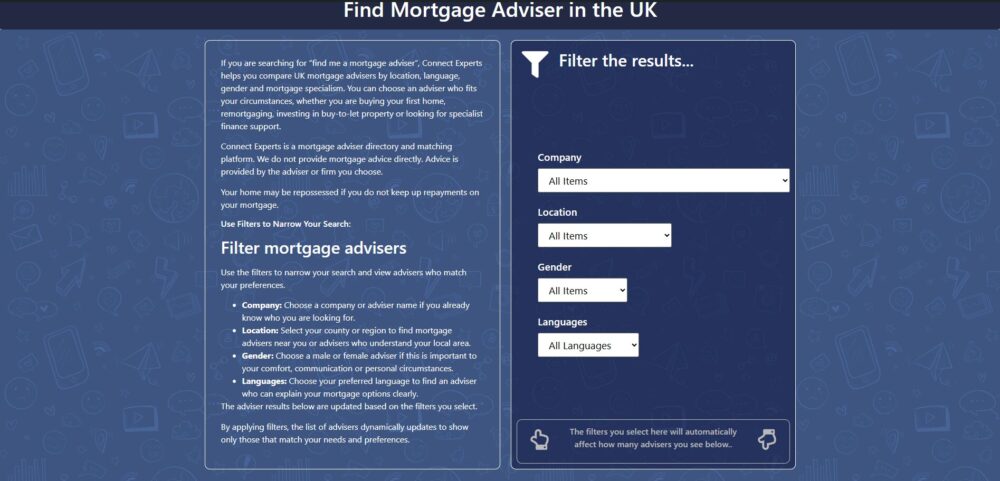
Connect Experts is an adviser directory connected with the wider Connect Group. Users can search for advisers by location, mortgage need and other preferences.
Eligible network advisers may gain a directory profile that helps potential clients search for a commercial mortgage adviser.
Connect Experts is a directory and matching platform. Mortgage advice is provided by the adviser or firm selected by the customer.
A Practical Route into Commercial Mortgage Broking
Step 1: Review your current experience
Consider whether you already understand business finance, property investment, company accounts or specialist mortgage cases.
This helps identify the training and supervision you may require.
Step 2: Confirm permissions and regulatory scope
Establish which activities you will perform and whether they sit within your firm’s approved permissions.
Each case must also be assessed individually.
Step 3: Complete commercial finance training
Develop practical knowledge of lender criteria, commercial underwriting, financial evidence and case packaging.
Step 4: Work with experienced case support
Discuss early cases with commercial finance specialists before approaching lenders.
This can reduce unsuitable submissions and identify weaknesses before they delay the application.
Step 5: Build competence gradually
Begin with cases that match your knowledge and supervision arrangements.
More complex property, ownership or funding structures should follow as your competence develops.
Should You Join a Commercial Mortgage Network?
A network may suit advisers who want structured support rather than building every lender, compliance and technology relationship independently.
Before choosing a network, ask:
- Which commercial finance areas are supported?
- What training is available?
- How are permissions assessed?
- Who reviews complex cases?
- Is packaging or placement support available?
- Which technology is included?
- How are advisers supervised?
- Can the network support future business growth?
The purpose of a network is not to remove responsibility. It is to provide a framework in which responsibility can be exercised more consistently.
Become a Commercial Mortgage Broker with Connect
Connect supports mortgage advisers across mainstream and specialist finance, including commercial mortgages, buy-to-let, bridging and development finance.
The route can include training, lender access, placement support, compliance guidance, technology and continued development.
Your entry route will depend on your qualifications, experience, proposed activities and required permissions.
Speak to Connect about joining the network.
FAQs About Becoming a Commercial Mortgage Broker
What qualifications do commercial mortgage brokers need?
The requirements depend on the activities performed and whether the transaction is regulated. Relevant training, practical competence and appropriate permissions remain essential.
Are all commercial mortgages unregulated?
No. Regulatory status depends on the borrower, security, property use and transaction. Each case should be assessed on its facts.
Can a residential mortgage adviser move into commercial finance?
Yes, subject to suitable training, competence, permissions and supervision. Existing residential experience can help, but commercial underwriting requires additional knowledge.
What documents are needed for a commercial mortgage?
Requirements vary. They may include accounts, bank statements, leases, tenancy schedules, business plans, property details and evidence of deposit.
How does a network help commercial mortgage brokers?
A network may provide lender access, training, case placement, technology, supervision and compliance support. The exact service should be checked before joining.