

When Mortgage Advice Adds the Most Value: Mortgage advice does not have the same value in every application.
Its value increases when a case contains more variables. These may involve income, affordability, credit history, property type, lender criteria or future plans.
For mortgage advisers, these cases require more than a product search. They require accurate evidence, suitable lender selection and a recommendation that can withstand regulatory scrutiny.
At a Glance
Mortgage adviser expertise is often most valuable when:
- income does not fit a standard employed model;
- the property falls outside common lender criteria;
- the client has credit issues or previous declines;
- borrowing involves buy-to-let or commercial property;
- a remortgage includes capital raising or debt consolidation;
- the client’s future plans affect the product structure;
- lender criteria must be interpreted before an application is submitted.
A strong mortgage network helps advisers research, document and place these cases correctly.
Why Mortgage Advice Becomes More Valuable
A mortgage rate is only one part of a recommendation.
An adviser must also consider affordability, fees, early repayment charges, product flexibility, lender criteria and the client’s expected circumstances.
The FCA reported £77.6 billion of gross mortgage advances during the first quarter of 2025. This was the highest quarterly amount since the final quarter of 2022.
However, lending volume does not make every case straightforward. Higher-value advice is usually needed when several lending rules apply at the same time.
The important question is not simply:
Which lender has the lowest advertised rate?
It is:
Which available mortgage remains suitable after the client’s full circumstances, costs and plans are considered?
When Adviser Expertise Adds the Most Value
Complex or Variable Income
Income assessment can become more technical when a client is:
- self-employed;
- a contractor;
- paid through salary and dividends;
- receiving regular commission or bonuses;
- using income from several sources;
- approaching retirement.
Lenders may use different accounting periods, income calculations and evidence requirements.
An adviser can identify which lenders are more likely to accept the income structure before a full application is made. This reduces avoidable submissions and protects the client’s time.
Credit Issues and Previous Applications
A low credit score does not explain the complete case.
The type, value, age and reason for a credit issue may all affect lender eligibility. A missed mobile payment can be treated differently from recent mortgage arrears or an unsatisfied county court judgment.
Adviser value comes from establishing:
- what happened;
- when it happened;
- whether the debt was satisfied;
- how the client has managed credit since;
- which lenders may consider the complete circumstances.
Submitting repeated applications without this research can create further difficulty.
Unusual Properties
Some properties require lenders with specific policies or valuation experience.
Examples can include:
- flats above commercial premises;
- non-standard construction;
- short leases;
- multi-unit properties;
- houses in multiple occupation;
- properties requiring substantial work;
- homes with restrictive occupancy conditions.
The mortgage product may be competitive, but that has little value if the property does not meet the lender’s security requirements.
Connect advisers can use the network’s specialist lending support to review more complex cases before submission.
Buy-to-Let and Portfolio Borrowing
Buy-to-let advice can involve rental stress testing, personal income, property ownership structures and existing portfolio commitments.
A portfolio landlord may also face different evidence requirements from a first-time landlord.
Limited company applications introduce further questions concerning:
- the company structure;
- director and shareholder guarantees;
- existing company borrowing;
- the property type;
- lender rules for special purpose vehicles.
These cases benefit from access to a broad mix of mainstream and specialist lenders.
Remortgaging and Raising Capital
A lower rate does not automatically make a remortgage suitable.
The adviser must assess:
- early repayment charges;
- arrangement, valuation and legal fees;
- the remaining mortgage term;
- the reason for raising funds;
- whether a further advance is available;
- the total cost of borrowing.
This is particularly important when funds are being raised for home improvements, investment or debt consolidation.
Extending borrowing over a longer mortgage term may reduce monthly payments while increasing the total amount repaid.
Bridging, Commercial and Short-Term Finance
Specialist finance is often time-sensitive.
An adviser may need to understand the purchase structure, exit strategy, property value, development costs and the borrower’s experience.
A workable exit is central to short-term lending. Without it, an attractive initial facility may create a greater refinancing risk later.
Advisers handling these enquiries can review Connect’s specialist mortgage network support.
Major Changes in the Client’s Circumstances
Advice may also become more valuable when the client is:
- moving home;
- changing employment;
- separating from a spouse or civil partner;
- approaching retirement;
- increasing or reducing working hours;
- planning further property purchases;
- reviewing family protection.
A mortgage should not only fit the client on the application date. The recommendation should consider foreseeable changes where these are known.
What Advisers Should Establish Before Research
A well-prepared case normally begins with four questions.
1. What is the client trying to achieve?
The objective may be lower payments, greater certainty, additional borrowing or a property purchase.
2. Which facts may restrict lender choice?
Income, credit history, property construction and deposit source may affect eligibility.
3. What evidence will the lender require?
Identifying documents early can prevent delays later.
4. What could change during the mortgage term?
Future employment, retirement or property plans can influence the recommended product.
Good advice turns these facts into a clear and supportable recommendation.
How a Mortgage Network Supports Better Advice
A mortgage adviser remains responsible for understanding the client and making a suitable recommendation.
However, the network behind the adviser can improve the process through:
- lender and provider access;
- specialist placement guidance;
- compliance support;
- case management systems;
- adviser training;
- file-quality feedback;
- business development support.
Connect Network supports advisers across mainstream mortgages, specialist lending, protection and general insurance.
Read more about the network’s wider adviser services.
Finding the Right Mortgage Adviser
Clients should look for an adviser whose permissions and experience fit the type of finance required.
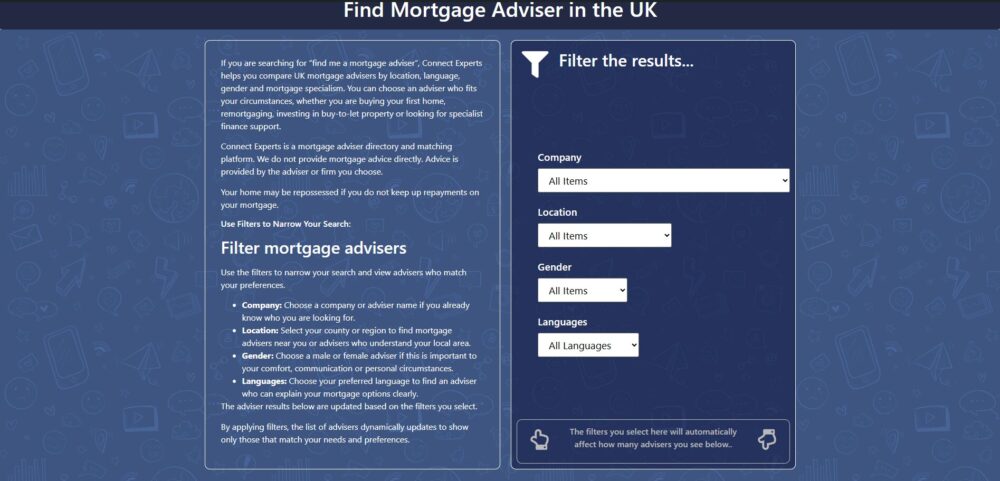
Connect Experts is the adviser directory for Connect Network and associated authorised firms.
Consumers can find a mortgage adviser by location, language and mortgage need.
Those with less common circumstances can also search for specialist mortgage and protection brokers.
Connect Experts is a directory and matching platform. Mortgage advice is provided by the adviser or firm selected by the customer.
Advice Matters Most When the Case Cannot Be Reduced to a Rate
Simple comparisons work when all other factors are equal.
Mortgage cases rarely remain equal once income, property, credit, timing and future plans are considered.
That is where adviser expertise creates its greatest value. It turns separate facts into a recommendation that is suitable, properly evidenced and practical to complete.
Mortgage advisers seeking broader lender access, compliance guidance and specialist case support can explore how to join Connect Network.
Frequently Asked Questions
When is using a mortgage adviser most important?
Mortgage advice is especially useful when income, credit history, property type or borrowing requirements fall outside standard lender criteria.
Can a mortgage adviser help after a lender declines an application?
An adviser can review the reason for the decline and assess whether another lender may use different criteria. Approval is never guaranteed.
Why does network support matter in a complex mortgage case?
A mortgage network can give advisers access to compliance guidance, specialist placement support, systems, training and a wider lender panel.
Does Connect Experts provide mortgage advice?
No. Connect Experts is an adviser directory and matching platform. Advice is provided by the adviser or authorised firm chosen by the customer.
Your property may be repossessed if you do not keep up repayments on your mortgage or any other debt secured on it. The FCA does not regulate all buy-to-let, commercial mortgage or business finance products.