
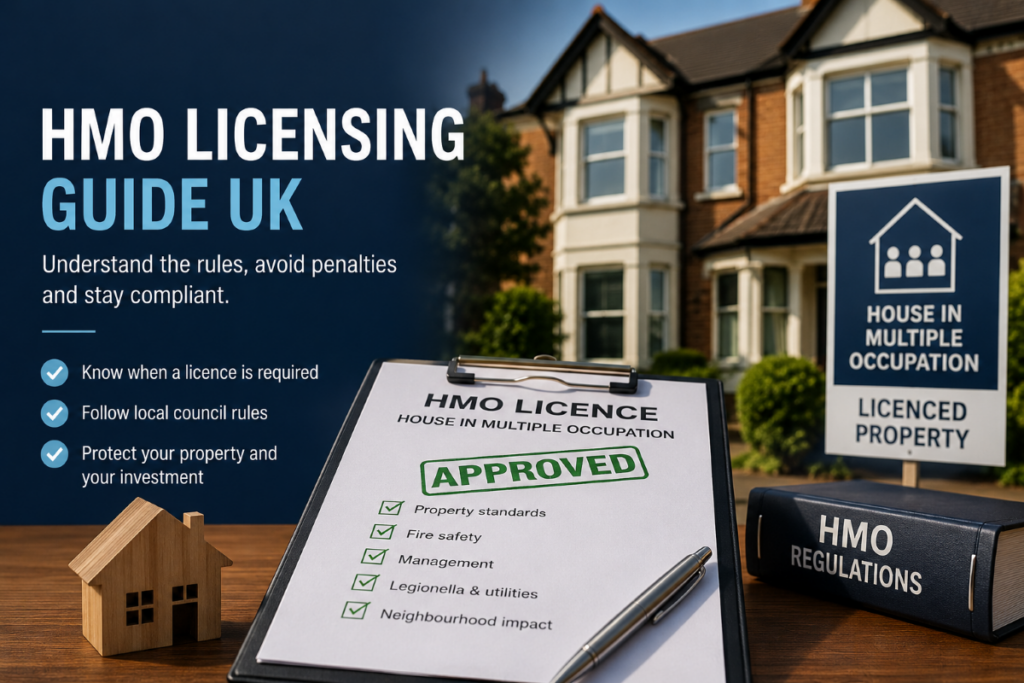
HMO Licensing Guide UK: An HMO licence may be needed when a property is rented to several people who are not from the same household and share facilities such as a kitchen, bathroom or toilet.
This HMO licensing guide explains when a licence is required, how local council rules work, what landlords may need before applying, and why licensing matters when arranging or reviewing HMO finance.
For brokers and advisers, HMO licensing is also an important part of understanding landlord cases. A property that appears suitable from a rental income perspective may still raise questions around planning, licensing, property standards, fire safety and lender criteria.
What is an HMO?
An HMO is a house in multiple occupation. In simple terms, it is usually a property where at least three tenants live there, the tenants form more than one household, and they share facilities such as a kitchen, bathroom or toilet.
A household can be one person or members of the same family living together. Unrelated tenants are usually treated as separate households.
This means a property may be an HMO if it is let to:
- Three or more unrelated tenants
- Two or more separate households
- Tenants who share kitchen, bathroom or toilet facilities
Not every HMO needs a mandatory licence, but every landlord should check the local council rules before letting a shared property.
When Does an HMO Licence Apply?
A mandatory HMO licence is usually required when a property is rented to five or more people who form more than one household and share toilet, bathroom or kitchen facilities.
This is often called a large HMO.
A licence may also be required for smaller HMOs if the local council has introduced additional licensing. This can affect properties with three or four tenants in more than one household.
Some councils also operate selective licensing schemes. These can apply to privately rented properties in certain areas, even where the property is not a large HMO.
Mandatory HMO Licensing Rules
Mandatory HMO licensing applies to larger shared properties. A landlord should expect a licence to be required where:
- Five or more tenants live in the property
- The tenants form more than one household
- At least some tenants share a kitchen, bathroom or toilet
- At least one tenant pays rent, or rent is paid on their behalf
The previous three-storey requirement no longer applies in England. This means many two-storey and single-storey shared homes can still fall within mandatory HMO licensing.
Landlords should check the property layout, the number of occupiers, the relationship between occupiers, and the local authority requirements before tenants move in.
Additional and Selective Licensing
Mandatory licensing is not the only rule landlords need to consider.
Some councils require smaller HMOs to be licensed through additional licensing schemes. These schemes often apply to properties with three or four tenants from more than one household.
Selective licensing is different. It can apply to private rented homes within a defined local area. A selective licensing scheme may affect landlords even where the property is let to a single household.
Because local rules vary, landlords should always check the council website for the property address. A property that does not need a licence in one council area may need one in another.
Why Local Council Rules Matter
HMO licensing is managed by local councils. This means the licence fee, application process, documents required and property standards can vary by area.
A council may check whether:
- The property is suitable for the number of occupiers
- Bedrooms meet minimum space expectations
- Shared facilities are suitable
- Fire safety measures are adequate
- Waste disposal arrangements are suitable
- The landlord or manager is a fit and proper person
- Gas, electrical and safety documents are up to date
Landlords should not rely only on national rules. Local authority checks are often the deciding factor.
HMO Licensing Checklist
| HMO licensing point | What to check |
|---|---|
| Number of tenants | Confirm how many people will live in the property |
| Household structure | Check whether tenants form one household or more than one household |
| Shared facilities | Confirm whether tenants share a kitchen, bathroom or toilet |
| Council scheme | Check whether the local council has mandatory, additional or selective licensing |
| Property suitability | Review room sizes, facilities, fire safety and waste arrangements |
| Licence holder | Confirm who will hold the licence and manage the property |
| Documents | Prepare gas safety, electrical safety, fire safety and property information where required |
| Renewal date | Track the licence expiry date and renew before it ends |
How to Apply for an HMO Licence
A landlord usually applies through the local council responsible for the property address.
The process normally involves:
- Checking whether the property needs a licence.
- Completing the council’s HMO licence application form.
- Providing property details, layout information and occupier details.
- Supplying safety documents where required.
- Paying the council’s licence fee.
- Responding to any council questions or inspection requests.
- Displaying or keeping licence information as required by the council.
Some landlords apply directly. Others use a managing agent, although the landlord remains responsible for ensuring the property is properly licensed.
How Long Does an HMO Licence Last?
An HMO licence can last for up to five years.
The licence must be renewed before it expires. A landlord also needs a separate licence for each HMO property they operate.
If the licence holder, manager, property layout or occupancy changes, the council may need to be informed. Landlords should check the licence conditions and keep records throughout the licence term.
HMO Licence Costs
HMO licence fees are set by the local council. Costs vary depending on the area, the property size, the number of rooms and the council’s charging structure.
A landlord may also need to budget for works linked to licensing, such as fire doors, alarms, electrical works, room adjustments, waste storage, documentation or management changes.
The licence fee is only one part of the overall cost. Before buying, refinancing or converting an HMO, landlords should consider the full compliance budget.
Penalties for Operating an Unlicensed HMO
Operating an HMO without the correct licence can create serious consequences.
Possible penalties include:
- Unlimited fines
- Civil penalties from the local council
- Rent repayment orders
- Restrictions on serving certain notices
- Enforcement action linked to property standards
- Reputational damage for landlords and managing agents
An unlicensed HMO may also create problems when arranging finance. Lenders may ask questions about property use, licensing, tenancy structure and whether the property meets local requirements.
HMO Licensing and Mortgage Advice
HMO finance can be more complex than standard buy-to-let lending. Lenders may assess the property type, number of rooms, rental income, landlord experience, licence position, planning position and management structure.
A landlord may need advice before:
- Buying an HMO
- Refinancing an existing HMO
- Converting a property into an HMO
- Moving from a standard buy-to-let to an HMO model
- Expanding a landlord portfolio
- Purchasing through a limited company
- Funding refurbishment before letting rooms
If you are a landlord looking for an adviser support, you can search for an HMO mortgage adviser through Connect Experts.
For wider landlord finance needs, you can also search for a buy-to-let mortgage adviser who can help you explore the right adviser route based on your property plans.
Why HMO Licensing Matters for Brokers
Experienced brokers know that HMO cases need more than a rental calculation. Licensing, planning, valuation comments, tenancy setup, fire safety, landlord experience and lender appetite can all affect the route forward.
This is where network support can make a difference.
Connect for Intermediaries supports advisers across mainstream and specialist mortgage areas, including residential, buy-to-let, commercial, bridging, second charges, protection and general insurance. That wider structure helps advisers avoid being limited to one narrow part of the market.
Brokers who regularly handle landlord, portfolio or HMO cases may benefit from access to wider lender panels, specialist placement support, packaging support, compliance guidance, technology and ongoing training.
If you are an experienced adviser reviewing your network options, you can learn more about the Connect mortgage and protection network and how it supports brokers across a broad range of client needs.
Connect is a Complete Mortgage and Protection Network
Connect is not only a specialist mortgage network. It is a complete mortgage and protection network designed to support advisers across mainstream and specialist client needs.
That matters because real client cases often cross categories.
A landlord may also need protection advice. A residential client may later become a buy-to-let investor. A business owner may need commercial finance. A client with a complex income structure may still need a mainstream residential mortgage. A broker needs a network that can support the full client journey, not just one type of case.
Connect supports advisers with access to a wide range of lenders and providers, compliance support, case placement, adviser services, training, technology and a national adviser community.
For advisers who want to grow, this creates a broader platform for long-term client relationships.
HMO licensing FAQs
| Question | Answer |
|---|---|
| Do all HMOs need a licence? | No. Large HMOs usually need a mandatory licence, but smaller HMOs may also need a licence if the local council operates additional licensing. Landlords should check with the council for the property address. |
| What is a large HMO? | A large HMO is usually a property rented to at least five people who form more than one household and share facilities such as a kitchen, bathroom or toilet. |
| Can a three-person house share need an HMO licence? | Yes. A three-person house share may not meet mandatory large HMO licensing rules, but it may still need a licence if the council has an additional licensing scheme. |
| Who issues an HMO licence? | The local council issues the HMO licence. The council also sets the fee, checks the property and confirms licence conditions. |
| How long does an HMO licence last? | An HMO licence can last for up to five years. It must be renewed before it expires. |
| Can an unlicensed HMO affect a mortgage application? | Yes. Lenders may ask whether the property is correctly licensed and suitable for the proposed letting arrangement. Licensing issues can delay or affect a mortgage application. |
| Should landlords check licensing before applying for finance? | Yes. Landlords should check licensing, planning and property suitability before applying for HMO finance. This can reduce delays and help the adviser present the case more clearly to lenders. |