

Self-employed mortgage cases are not difficult simply because the applicant runs a business. The difficulty often comes from how income is structured, recorded and interpreted.
A sole trader, contractor and limited company director may earn similar amounts. However, a lender may assess each applicant differently.
For mortgage advisers, good case preparation begins before sourcing. It means understanding the business, checking the evidence and identifying how each lender calculates sustainable income.
At a Glance
Self-employed applicants may need to provide accounts, tax calculations, tax year overviews, bank statements or contract evidence.
The documents required will depend on the applicant’s trading structure and the lender’s criteria. Advisers should establish the source of income, review recent performance and check whether profits are stable, rising or falling.
A clearly packaged case can help the lender understand the applicant’s financial position. However, each application remains subject to affordability, credit, property and lending criteria.
What Counts as Self-Employed Income?
Self-employed applicants do not all receive income in the same way. The first task is to identify the applicant’s legal and financial structure.
Common structures include:
- sole traders;
- business partners;
- limited liability partnership members;
- contractors;
- freelancers;
- limited company directors;
- shareholders receiving salary and dividends.
This distinction matters because the figure shown in a business bank account may not be the income a lender uses for affordability.
Turnover, gross profit, net profit, salary, dividends and retained profit are separate measures. Advisers should confirm which figure a lender will assess before producing an affordability illustration.
How Lenders May Assess Different Business Structures
Sole Traders
A lender will commonly assess a sole trader using declared taxable profit. This may be evidenced through tax calculations, tax year overviews and business accounts.
Some lenders average income across recent trading years. Others may use the latest year where income has fallen.
A strong latest year does not automatically mean the highest figure will be accepted. Advisers should examine the full pattern rather than relying on one headline number.
Partnerships and LLPs
For partnerships, lenders may assess the applicant’s individual share of profit.
The partnership accounts, tax records and ownership agreement should tell a consistent story. Any material change in profit share or ownership may require further explanation.
Limited Company Directors
Many lenders begin with the director’s salary and dividends. Some may consider the applicant’s share of retained profit where their criteria allow it.
Retained profit treatment varies widely. The adviser should check:
- the applicant’s ownership percentage;
- whether the business remains profitable;
- whether cash is available within the company;
- whether extracting more income would affect the business;
- whether the lender uses profit before or after corporation tax.
A lender accepting retained profit may produce a different affordability result from one using salary and dividends alone.
Contractors
Contractor income may be assessed through accounts, day-rate calculations or current contract evidence.
The lender may consider the contract term, remaining duration, employment history, gaps between contracts and experience within the same sector.
Advisers should not assume that every contractor must be assessed through self-employed accounts. The correct route depends on the applicant’s working arrangement and the lender’s definition.
What Evidence May Be Required?
Evidence should establish both the amount and sustainability of the income.
Depending on the case, lenders may request:
- finalised business accounts;
- SA302 tax calculations;
- corresponding tax year overviews;
- personal bank statements;
- business bank statements;
- current and previous contracts;
- an accountant’s reference;
- dividend vouchers;
- payslips issued by the applicant’s company;
- confirmation of company ownership.
HMRC explains how taxpayers can obtain an SA302 tax calculation and tax year overview when proof of earnings is required for a mortgage application.
The documents should agree with each other. Unexplained differences between accounts, tax records and bank statements can delay underwriting.
Can an Applicant Apply With One Year’s Accounts?
Some lenders may consider an applicant with one completed trading year. This does not mean every recent business will qualify.
The lender may examine:
- previous employment in the same industry;
- current contracts or confirmed future work;
- business performance since the year-end;
- deposit size;
- credit conduct;
- personal and business commitments;
- the reason for becoming self-employed.
A new business supported by relevant industry experience may be viewed differently from an entirely new venture.
Advisers should establish the complete background before selecting a lender.
Warning Signs to Check Before Submission
A lender may ask further questions where the evidence shows:
- falling profit;
- increasing business debt;
- heavy use of an overdraft;
- unpaid tax;
- substantial income taken from reserves;
- a recent change in company structure;
- irregular large credits;
- unexplained gaps between contracts;
- dependence on one customer;
- accounts that are significantly out of date.
These points do not always prevent lending. However, they should be identified and explained before submission.
A concise case summary can clarify the applicant’s position and reduce avoidable questions.
A Practical Adviser Checklist
Before recommending a lender, confirm:
- The applicant’s exact trading structure.
- Their ownership share and income sources.
- The number of completed trading years.
- Whether profits are rising, stable or falling.
- Which income figure the proposed lender will use.
- Whether all tax and accounting evidence is available.
- Whether business and personal commitments are recorded correctly.
- Whether recent changes require an explanation.
- Whether the case meets current credit and property criteria.
- Whether specialist placement support is needed.
The purpose is not to make the case appear simpler than it is. It is to present the facts in a form the underwriter can assess efficiently.
How a Mortgage Network Can Support These Cases
Self-employed cases may require access to lenders with different approaches to trading history, contractor income, salary, dividends and retained profit.
Connect Network supports advisers through mortgage adviser services, including lender access, placement assistance and case-management support.
Network support may help an adviser:
- identify relevant lender criteria;
- discuss a case before submission;
- understand evidence requirements;
- avoid unsuitable applications;
- package complex income clearly;
- maintain suitable compliance records.
Connect also provides wider support for UK mortgage advisers, including training, technology, compliance guidance and business development resources.
Connecting Clients With Suitable Advisers
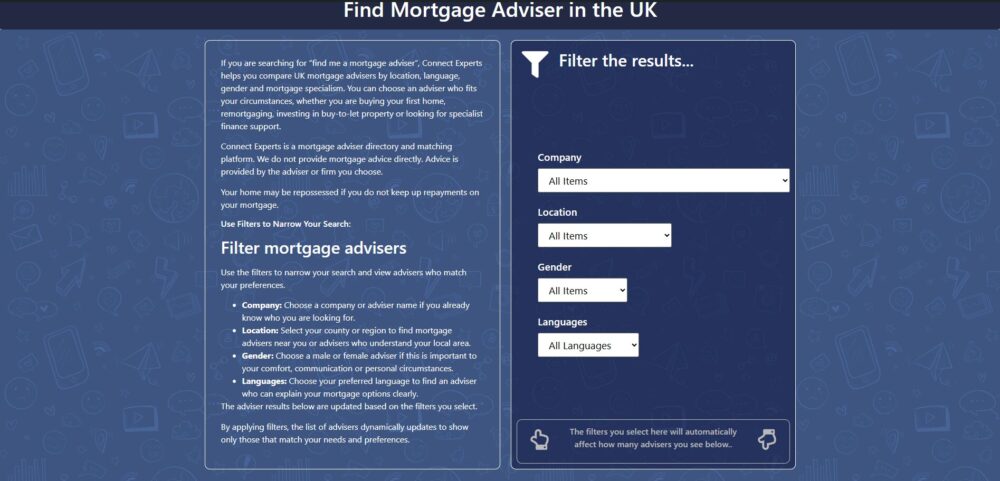
Connect Experts provides a consumer-facing directory where users can search for advisers by mortgage need, location and other preferences.
The self-employed mortgage broker directory helps consumers identify advisers who may have experience with self-employed income.
Connect Experts is a directory and matching platform. It does not provide mortgage advice directly. Advice is given by the adviser or firm selected by the customer.
For eligible Connect appointed representatives, directory visibility can support a clearer route between specialist adviser skills and relevant consumer enquiries.
Better Evidence Supports Better Decisions
A self-employed mortgage case is not only a set of accounts. It is a record of how a person earns, manages and sustains income.
Good advice requires more than locating a lender prepared to consider the applicant. It requires an accurate understanding of the figures and a recommendation supported by current criteria.
Advisers who want broader lender access, placement assistance and network infrastructure can learn more about how to join Connect Network.
All applications remain subject to lender affordability, credit, property and underwriting requirements.
Frequently Asked Questions
How many years of accounts does a self-employed mortgage applicant need?
Requirements vary. Many lenders request two or more completed years, while some may consider one year where the wider case supports the application.
Do all lenders use salary and dividends for company directors?
No. Many use salary and dividends, while some may consider the applicant’s share of retained profit. The calculation method depends on lender criteria.
Can an adviser use an SA302 without a tax year overview?
A lender may request both documents. Advisers should check that the figures correspond and meet the lender’s current evidence requirements.
Does higher business turnover increase mortgage affordability?
Not necessarily. Turnover is not the same as personal income or business profit. Lenders normally assess an accepted measure of sustainable income.
Why should advisers check criteria before submitting?
Self-employed income calculations differ between lenders. An early criteria check can reduce unsuitable applications, duplicated credit searches and underwriting delays.