

When Do Clients Need a Mortgage Adviser? A client may not be legally required to use a mortgage adviser. However, advice can become valuable when the mortgage decision involves complex income, specialist criteria or uncertainty about product suitability.
The question is therefore not simply whether a client can apply without advice. It is whether they understand the financial commitment, lender requirements and consequences of the mortgage selected.
At a Glance
A client may benefit from mortgage advice when:
- their income or credit history is complex;
- they are unsure which lenders may accept their circumstances;
- the property falls outside standard lending criteria;
- they need help assessing affordability and mortgage features;
- they want a professional recommendation;
- they require support preparing and managing the application.
An adviser cannot guarantee approval. However, suitable research and accurate case preparation may reduce avoidable applications to unsuitable lenders.
Mortgage Advice in the 2024 Lending Environment
As at April 2024, lenders continued to assess applicants through their own affordability models, credit policies and property criteria.
Two clients with similar incomes could therefore receive different outcomes. Their debts, employment structure, deposit, credit record and property type could all affect the decision.
A mortgage adviser considers these factors before recommending a suitable course of action.
For advisers, this is where professional judgement matters. A mortgage is not selected through the interest rate alone. The lender’s criteria, fees, repayment structure and underwriting approach must also fit the client.
Connect Network supports brokers across mainstream and specialist cases through its adviser services.
When Is Mortgage Advice Most Relevant?
The Client Has Complex Income
Standard salaried income may be easier for lenders to assess. Other income structures can require more detailed evidence.
These may include:
- self-employed profits;
- limited company income;
- bonuses or commission;
- contract income;
- income from several jobs;
- pension or investment income;
- rental income.
Lenders may calculate these income types differently. An adviser can establish which figures a lender may use and which documents will be required.
The Client Has Credit Issues
Missed payments, defaults, county court judgments or a limited credit history do not always prevent a mortgage application.
However, the timing, value and reason for the credit event may affect lender selection.
An adviser should review the available information before submitting an application. This can help avoid unnecessary credit searches with lenders whose criteria are unlikely to fit the case.
The Property Is Unusual
Some properties require more detailed lender research.
Examples include:
- flats above commercial premises;
- properties with short leases;
- non-standard construction;
- houses in multiple occupation;
- mixed-use buildings;
- properties requiring refurbishment;
- homes bought through specialist schemes.
A lender may accept the client but decline the property. Advice must therefore consider both the borrower and the security.
The residential mortgage guide explains the core elements lenders assess within residential cases.
The Client Has a Small Deposit
A smaller deposit can reduce the number of available products and increase the importance of affordability.
The adviser may need to assess:
- the source of the deposit;
- whether any part is gifted;
- the required loan-to-value;
- lender affordability limits;
- product fees;
- the effect of the rate on monthly payments.
The lowest advertised rate is not automatically the lowest overall cost. Fees and product structure also need to be considered.
The Client Is Unsure About Mortgage Features
A mortgage may include fixed, variable, tracker, offset or interest-only features.
Clients also need to understand:
- early repayment charges;
- arrangement fees;
- overpayment allowances;
- portability;
- repayment methods;
- mortgage term;
- total amount repayable.
Advice gives the client a personal recommendation based on their stated circumstances and objectives.
When Might a Client Apply Without Advice?
A client may choose an execution-only route when they already know which mortgage they want and meet the lender’s requirements.
However, the client must understand that the lender or intermediary has not assessed the product’s suitability in the same way as an advised recommendation.
Execution-only applications may therefore be more appropriate for clients who:
- understand the product and its risks;
- can compare the full costs;
- know the lender’s eligibility requirements;
- are comfortable completing the process without a recommendation.
Confidence alone does not establish suitability. A client must understand both the mortgage and the consequences of choosing it.
What Does a Mortgage Adviser Assess?
A mortgage adviser normally reviews:
- The client’s income and expenditure.
- Existing credit commitments.
- Deposit and source of funds.
- Credit history.
- Property type and intended use.
- Preferred mortgage term.
- Attitude towards payment changes.
- Relevant lender criteria.
- Product fees and repayment features.
- The client’s objectives and future plans.
The adviser then explains the recommendation and why it is considered suitable.
Mortgage approval remains subject to the lender’s affordability checks, underwriting, valuation and final decision.
Why Network Support Matters
The client sees the recommendation. Behind it sits research, compliance, documentation and lender communication.
A mortgage network can help its appointed representatives through:
- lender and provider access;
- compliance oversight;
- case-placement support;
- training and professional development;
- technology and case-management systems;
- support with mainstream and specialist applications.
Connect Network also provides eligible AR members with visibility through the Connect Network adviser directory.
This helps connect the adviser’s professional work with clients who are actively searching for mortgage support.
How Clients Can Find a Mortgage Adviser
Clients should consider the adviser’s permissions, experience, fees and relevant mortgage expertise.
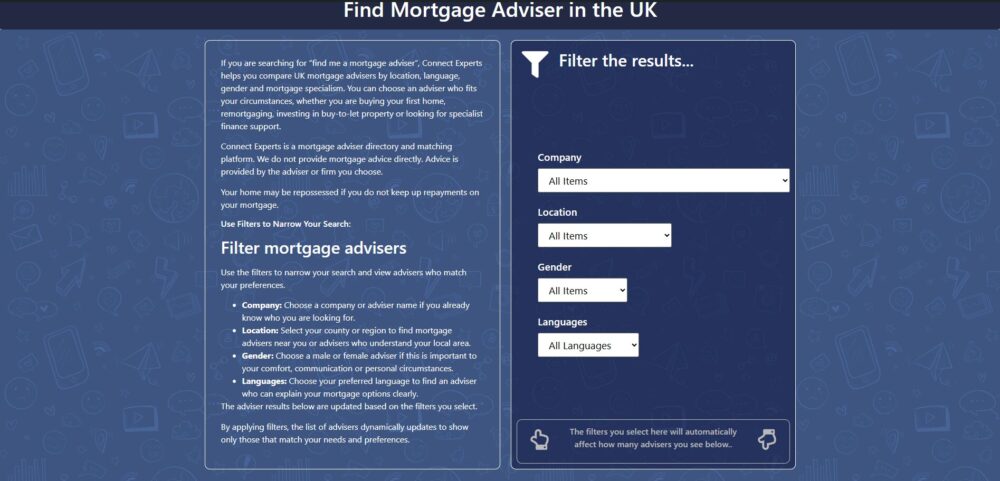
Connect Experts is a separate adviser directory and matching platform. It does not provide mortgage advice directly. Advice is provided by the adviser or firm selected by the client.
Clients can:
- find mortgage advisers by mortgage need, language and other preferences; or
- find a mortgage adviser by location when local knowledge or face-to-face contact is important.
Any fees should be explained before the client agrees to proceed.
The Practical Answer
Clients do not always need a mortgage adviser to submit an application.
However, advice becomes more valuable as the client’s income, credit profile, property or borrowing objectives become more complex.
Technology can present mortgage products. It cannot decide whether the product fits the client’s full circumstances without the right information and assessment.
The practical role of the adviser is to turn that information into a suitable recommendation and a properly prepared application.
Frequently Asked Questions
Does every mortgage applicant need an adviser?
No. Some applicants may choose an execution-only application. However, they will not receive a personal recommendation based on suitability.
Can a mortgage adviser guarantee approval?
No. The lender makes the final decision after completing its affordability, credit, underwriting and property checks.
Can an adviser help a self-employed client?
Yes. An adviser can review how different lenders may assess accounts, tax calculations, salary, dividends and retained profits.
Do mortgage advisers charge fees?
Some advisers charge a fee and others may receive commission from the lender. The adviser should explain the amount, timing and basis of any fee before the client proceeds.
Is Connect Experts a mortgage advice firm?
Connect Experts is an adviser directory and matching platform. Mortgage advice is provided by the selected adviser or their firm.
Important: Your home may be repossessed if you do not keep up repayments on your mortgage or another loan secured against it.