

How Mortgage Advice Turns Criteria Into Better Decisions: Mortgage advice creates value by turning personal circumstances, lender rules and product costs into a documented recommendation.
A rate table can show available products. However, it cannot establish whether a customer meets the lender’s criteria or whether the mortgage remains suitable after fees, restrictions and future payment changes are considered.
For advisers, value is therefore created through the quality of the research, reasoning and evidence behind the recommendation.
At a Glance
Mortgage advice is more than finding an interest rate.
An adviser assesses the customer’s circumstances, researches lender criteria, compares total costs and explains relevant risks. They also prepare the evidence needed to support the application.
The result should be a suitable and clearly documented recommendation rather than a product selected from headline pricing alone.
Why Mortgage Advice Begins With Evidence
Every mortgage recommendation starts with information.
An adviser needs to understand the customer’s income, commitments, deposit, credit position, property plans and expected changes. The accuracy of this information affects every later stage of the process.
The adviser may review:
- Employment and income evidence
- Business accounts or tax calculations
- Bank statements and regular commitments
- Deposit sources
- Credit history
- Property type and intended use
- Expected changes to income or expenditure
- The customer’s preferred payment structure
This fact-finding stage gives the recommendation its foundation. Without reliable information, even an attractive mortgage product may be unsuitable or unavailable.
How Advisers Interpret Lender Criteria
Mortgage lenders do not assess every applicant in the same way.
They may use different rules for variable income, overtime, bonuses, self-employed profits, contracting history or existing credit commitments. Property construction, lease terms and intended use may also affect eligibility.
An adviser compares the customer’s circumstances against these criteria before deciding where an application may fit.
This research can reduce avoidable applications to lenders whose policies do not match the case. It can also identify evidence requirements before the application reaches underwriting.
Connect Network supports its members with lender access, case placement and practical adviser services across mainstream and specialist finance.
Affordability Is More Than an Income Multiple
A lender’s affordability result is not simply a fixed multiple of annual income.
Assessments can include:
- Earned and non-earned income
- Credit commitments
- Dependants
- Household expenditure
- Mortgage term
- Interest-rate assumptions
- Expected retirement age
- Rental income for buy-to-let cases
Two lenders can therefore reach different results using the same customer information.
The adviser’s role is not to search for the highest possible loan without context. It is to identify an appropriate borrowing structure and explain how the payments may affect the customer’s wider finances.
Headline Rates Do Not Show the Full Cost
The lowest advertised rate is not automatically the lowest-cost mortgage.
A meaningful comparison may include:
- Product fees
- Valuation costs
- Legal incentives
- Cashback
- Early repayment charges
- Reversion rates
- Mortgage term
- Initial payment
- Total cost during the selected period
A product with a lower rate but a large fee may cost more than a higher-rate alternative. The outcome can depend on the amount borrowed and how long the customer expects to keep the product.
Advice adds value by placing the rate within the complete cost structure.
Suitability Connects the Research to the Customer
Product availability and product suitability are different questions.
A mortgage may be available but still conflict with the customer’s plans. Someone expecting to move soon may need to consider early repayment charges. A customer seeking payment certainty may place greater value on a fixed period. Another may need flexibility for overpayments.
The adviser must connect the technical product features to the customer’s objectives.
This turns research into a reasoned recommendation rather than a list of possible mortgages.
Application Management Protects the Decision
The quality of an application can affect its progress.
Missing documents, inconsistent information or an unsuitable lender selection may create delays. Advisers help organise the case before submission and respond to further underwriting requests.
Application support may include:
- Checking required evidence
- Explaining lender questions
- Coordinating with solicitors and estate agents
- Monitoring mortgage-offer conditions
- Reviewing material changes before completion
- Keeping a clear record of the recommendation
This work does not guarantee approval. The lender retains responsibility for its lending decision. However, a well-prepared application gives the lender clearer evidence on which to assess the case.
The Network’s Role Behind Mortgage Advice
An adviser’s work is supported by the systems and controls surrounding the advice process.
A mortgage network can provide compliance oversight, lender access, training, technology and case support. These functions help appointed representatives maintain consistent processes while working across different types of lending.
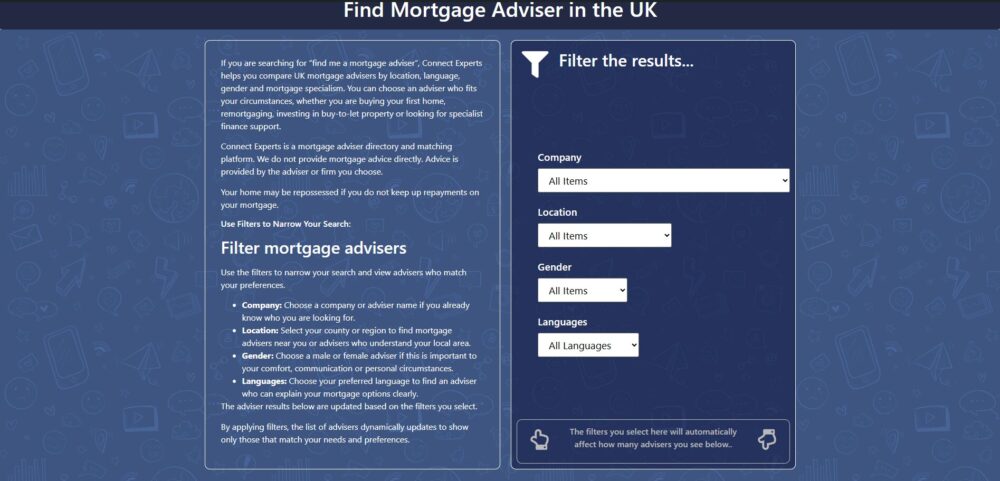
Connect Network also gives member advisers a route into the Connect Experts directory. This helps consumers search for advisers by location, mortgage need and personal preferences.
Advisers considering this structure can learn more about how to join Connect Network.
How Consumers Can Choose an Adviser
The value of advice also depends on choosing an adviser whose permissions and experience fit the customer’s needs.
Consumers should consider:
- The adviser’s regulatory status
- Relevant mortgage experience
- The range of lenders considered
- Advice and arrangement fees
- Communication preferences
- Experience with specialist circumstances
Connect Experts is a directory and matching platform. It does not provide mortgage advice directly. Consumers can use it to find a mortgage adviser or search for a Mortgage adviser near them.
Advice is provided by the adviser or firm selected by the customer.
A Technical Process With a Human Purpose
Mortgage advice combines regulation, research, evidence and judgement.
Its practical value is not found in a single rate or lender. It is found in the disciplined process that connects a customer’s circumstances to an appropriate recommendation.
The technology used to search the market will continue to develop. Google, digital sourcing systems and AI can make information easier to locate. However, information must still be checked, interpreted and applied to the individual case.
Tools can improve the search. Advice gives the search meaning.
Frequently Asked Questions
What creates value in mortgage advice?
Value is created through fact-finding, affordability assessment, lender research, cost comparison, suitability and application support. These stages help connect the customer’s circumstances to an appropriate recommendation.
Does a mortgage adviser guarantee approval?
No. The lender makes the final decision. An adviser can research suitable lenders, prepare evidence and reduce avoidable problems, but cannot guarantee an offer.
Is the lowest mortgage rate always the best option?
No. Fees, incentives, early repayment charges, mortgage term and product restrictions can change the overall cost and suitability of a mortgage.
What is the difference between Connect Network and Connect Experts?
Connect Network supports mortgage advisers and appointed representative firms. Connect Experts is a consumer directory and matching platform featuring advisers from the Connect network or associated authorised firms.